Thursday, 17 March 2011

BOY MEETS GIRL...in Medieval Florence


Watsonworksblog.blogspot.com
No. 21


Boy meets Girl
An extract from a new story

Besieged: The Coils of The Viper

Introduction

The mercenary armies of Gian Galeazzo Visconti, Duke of Milan, called The Viper, have brought terror to Italy. Cities such as Siena, Perugia and Bologna, have either been overcome in battle or been terrified into submission.

Florence alone stands out against him. In the burning hot summer of 1402, the Viper has laid siege to the city, his intention to starve the citizens until they are too weak to resist.

In the refectory of the priory of the Dominican brothers, the Master, one of Florence’s most distinguished artists, and Luca, his teenage apprentice, see no choice but to continue with the great fresco that the Master has been commissioned to paint. They know that once Visconti’s savage mercenaries breach the city walls few citizens will survive the brutality that has become the Viper’s trademark.

While escaping the heat of the August sun and sketching the masterpieces of Giotto in the gaunt but magnificent Santa Croce basilica, Luca has become aware of the girl in a brown robe, hovering in shadow as if compelled to look over his shoulder at what his skilful hand commits to the page. Will one of them pluck up the courage to speak?

The Girl in the Brown Robe
Selected from Chapter 3 and edited

…I’ve been sketching the figure of St. John the Evangelist and the petitioners kneeling around him. Usually, after I’ve been here in Santa Croce for a while, I’m recognised by one of the lay brothers. He pinched my cheek once, and I only smiled and shook my head. Since then he seems to haunt the chapel, and when he sees me he brings out a stool for me to sit on.
He pats my shoulder and leaves me to my sketching.
It looks as though the girl isn’t going to turn up. She’s become almost as regular a visitor as I am; about my age, curiously dressed – a brown woollen robe, complete with hood but cut short at the calf. I guess she bought or stole it from a mendicant friar, took if off his corpse or traded it for services rendered.
It’s that kind of world; everything is possible, and blame is as stupid as it can be unjust.
She usually wears rope sandals but at other times she appears out of the shadows barefoot. That’s how I think of her – a mystery; a sort of spirit. I never see her arrive, never see her depart. Yet I’ve decided her eyes are too bright for them to belong to a ghost. Her skin, though fresh, has the hue of dark leather; and there is the hint of a limp, making her rock slightly from side to side as she walks.

Hers is as beautiful a face as I’m likely to see in these blighted days, for the respectable daughters of Florence are kept indoors, unless they’re in service to the rich and need to chance the city streets to fetch and carry, or if their business is in the tanneries or the woolsheds along the Arno…

Today I promised myself I’d speak to her at last. All it needs is a word, a question, a smile. It’d be worth it merely to have her smile back, for so far she’s been as solemn as one of the angels my Master complains about in Santa Maria Maggiore; ‘joyless,’ he calls them.

I shouldn’t feel so disappointed that she’s not turned up. Only a fool gets his hopes up in these horrible times. My hand seems to lose its motivation to draw, and I realise the only reason I keep coming, poring over the Evangelist’s resurrection of Drusiana, over his Ascension or the Death of St. Francis, is to see her.

I realise I’m talking to myself and this is at the same moment that I sense her presence. She is close enough to see the page of my open sketchbook. I’ve been scribbling devils. She glances up at the fresco where there are no devils, and the drumming of my heart tells me she is about to break our silence.

Pointing up to Maestro Giotto’s fresco, she says, ‘Scusami, excuse me, but is that what you see?’

I amaze myself with my nerve: ‘I was thinking you wouldn’t come.’

The comment startles both of us. We evade each other’s embarrassment by staring up at the flowing robes of Giotto’s figures.

She seems to be pleased at my frankness. ‘You noticed?...I’m surprised, for you seem to concentrate so hard.’ I’m struggling to keep up with her, say the right words that won’t put her off; but she doesn’t need any help. ‘May I look?’

She almost brushes my shoulder as I turn the pages of my sketchbook. I say, ‘All very quick…Just, sort of, ideas on paper.’
‘Why do you like Giotto so much – because you sketch only his figures, don’t you?’
‘Because…well, they have volume, roundness. They’re solid – real.’
‘As if they’re about to step from the painting – alive?’
‘Yes, that’s it, exactly.’
I am pleased. Her interest is welcome, her perceptiveness obvious. ‘You see, so many paintings are just like the old mosaics – everything flat.’ I hear myself going on a bit, but I can’t rein in my enthusiasm. ‘They’ve no space, no perspective. They shut you out instead of drawing you in.’
‘Is that the secret – perspective?’
‘My friend Filippo swears it is. Perspective, he says, is the key to great art. Without it, we are left with pure decoration.’
‘Does it mean the same as having a perspective on life?’
I decide she’s half-teasing me, but I’m grateful for that half-smile and look forward to receiving a whole one. ‘That’s a bit more complicated,’ I manage to say. I return to my latest sketch.
‘That devil could be Gian Galeazzo the Viper, could it not?’
I nod. My pencil shifts to a space on the page and I begin to draw a coiled serpent – Gian Galeazzo’s emblem. There are seven coils narrowing to a pointed tail. Trapped in the final coil is a tiny human figure, struggling in terror. ‘That could be the people of Florence,’ I say, ‘in a few days’ time.’
‘You are very talented.’
‘Thank you.’
‘I suppose everyone tells you that.’
‘They did, once. But there’re no “everyones” any more.’
‘Are you an apprentice?’
‘For my sins.’
She blesses me with a full smile. ‘You look too innocent to be a sinner.’

They are clearing the church, locking up. The great works of Maestro Giotto have faded into shadow. I stand. She is tall, my height if not a shade taller. She is thinner than I remember her; yet close up, her face is truly beautiful, full of character (as the Maestro often describes his madonnas and his saints – ‘depth of character, that’s what counts, in art as in life’).
‘My guess,’ I say, determined to hold on to her company for as long as possible, ‘is you’re not from these parts, neither Florentine nor Tuscan.’
‘You can tell by my accent?’
We are outside in the piazza. Normally it would be crowded, but we are almost alone. The heat is as intense as it’s been since early morning, but now the atmosphere is clammy. ‘You’re from the north, I think.’
‘From Lombardy. Remember the Bianchi? I was one of them. When we marched here, Florence gave us the kind of welcome that made us want to stay.’
I laugh, remembering something the Master had said: ‘My Master approved of the Bianchi, and the city loved them, he says, because they paid their bills!’
‘True, but our cause – universal peace, that was what Florence welcomed.’
‘Peace, my Master says, is good for trade, and trade is Florence’s first religion.’
She takes the comment in good part. ‘Be a cynic, if you wish. But it was much more than that. There was a yearning among the people, for an end to wars and bloodshed. We felt it then and still do.’

We’ve strolled down to the river. There’s scarcely a dribble of water. A pale golden light still lingers on the façade of San Miniato high above us. The avenues of pine and cypress are deepening from green to black tinged with the last flashes of crimson along the horizon…
. ‘My name’s Luca, by the way.’
‘Caterina – come sta, how are you?’
‘Sto bene, grazie, I’m fine, thank you!’
We talk about Florence. ‘You are very proud of the city, aren’t you, Luca?’
‘And sometimes I’m ashamed of it. At its best, I love it. It was once beautiful, perhaps the most beautiful city on earth.’
‘Are you forgetting Venice?’
‘Never been, but the Master jokes about his visit there – “Too much water!” he said.’
Her face lights up every time she smiles. ‘Especially if you’re not looking where you’re going. I went there once. It does pong a bit. But as for Florence, it’s what the city stands for, isn’t it, which makes you Florentines proud?’…

Caterina puts her hand on my arm, shakes it gently with what I can only guess is affection. ‘I see Florence being truly great once more.’
I cannot believe it, but we are holding hands. ‘You seem very confident in the future,’ I say. ‘What are you – a fortune teller?’
She stares down at the riverbed where a child in rags is trying to scoop up water in a brass pot. ‘Perhaps I am…something like that. Or just an optimist.’ She glances again at the river. ‘The Arno looks as if it is dying, doesn’t it? But come the spring, everything will be different. The seasons bring hope.’..
I’m not so easily shifted from my dark mood. ‘Yes, and sometimes the floods wash away bridges. Nobody’s safe.’
For a moment we both sense that the floodtide is in ourselves, one of sadness and bereavement. Our fingers slip reluctantly apart. Defeat is in my voice: ‘It’s so difficult to hold on to hope when everything seems stacked against us.’
I guess that she is as loath to depart as I am. Her gaze meets mine, lingers… and I sense that if I had put my arms around her and hugged her she would match the strength of my feelings.
She is now holding out her hand towards me, formally, almost stiffly. ‘Till next time, perhaps.’ We shake hands. It is almost comical when really I would like to hold her and kiss her.
Her smile closes this, the happiest hour of my life. ‘Things to do.’ She turns, strides away, limping a little from the hip.
I call after her. ‘I would like to sketch you.’
She stops, faces me. The last light of the evening adds a splash of scarlet to her face and hair. ‘One sitting will cost you ten soldi.’
‘Can I pay you when I’m famous?’
‘A gold florin if I have to wait that long!’
I call after her one last time. ‘You didn’t say where you live.’
This time she does not look back. ‘No I didn’t.’ She heads towards the Ponte Vecchio leaving me suddenly empty, struck by melancholy as if I’d lost something precious that I might never recover.


NEXT: Girl Meets Girl
From
Fair Game: The Steps of Odessa.

****

A good read...

Anna Perera’s first novel took us into the horrific heart of Guantanamo. The detail was so well-worked, so convincing that it was difficult for the reader to believe that the author had not somehow undergone the experience of incarceration and torture herself.

In Anna’s new novel, The Glass Collector (Penguin), we get the same sense of sometimes overwhelming authenticity as in Guantanamo Boy. In both cases we are introduced to a scarcely imaginable world. Teenager Aaron, his family, his friends, his neighbours are Zabaleen Christians scratching out a desperate living in one of the poorest quarters of Cairo.

We gag at the stink. Nothing, anywhere, could be worse, more hazardous; yet Anna’s characters shine out of the ordure of rubbish collection just as do the fragments of glass, the coloured bottles which Aaron gathers and sometimes cherishes.

The Glass Collector punches hard and relentlessly. It deals with the isolation of a neglected community which nevertheless holds together and has a vital function in the greater order of Cairo life. At the same time, it is brave. What is striking among the young people Anna describes, and whose lives she portrays compassionately but with steely objectivity, is their lack of aspiration, the unwillingness to seriously contemplate escape.

True, an artist working on the local church gives Aaron a leg up when things are really down for the young thief, but once things are on an even keel, once his love for Rachel is reciprocated he does not aspire to be an artist, perceive that as a way out of his predicament; rather he returns happily it would seem, to the harsh but strangely rewarding reality of collecting a city’s discarded glass.

We can read here a lesson in belonging, that to be part of a community for all its often traumatising customs and pressures, is sometimes more powerful than western-style individualism and personal ambition. What we have here in Anna Perera’s excellent novel is an antidote to the prevalent values of our times. The life world she creates is impossible actually to desire, but somehow impossible not to admire.

***

As ever, contributions and correspondence are welcome, at http://Watsonworks@hotmail.co.uk

Tuesday, 15 February 2011

WATSONWORKS Blog 20

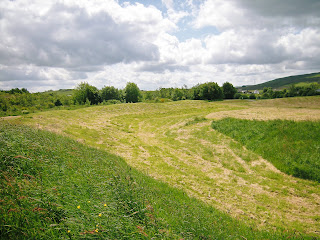
The Bull Ring, Derbyshire See Correspondence


Watsonworks Blog 20


Every story is a journey,
every journey an exploration

Stories operate across time and distance; they are exterior and interior explorations. As readers, we take a journey in the hope of resolution, and on the way it’s possible that things happen to us. In the best stories we enter in to the action through our own imagination and the alchemy of the writer. We seek escape, change, pastures new; and often having relished these pastures we return for more.

For the author the terrain that has been covered and re-covered by other writers resembles Egypt’s Valley of the Kings. On the face of it exhaustively worked, minutely excavated, the treasures seemingly dug up and carried away leaving bare patches of earth, there is the risk of accepting that the only new story is Journey’s End.

Bearings
Inspired by the likes of archeologist Howard Carter who persisted in his searches in the Valley of the Kings against learned advice, and came upon Tutankhamen, the dedicated writer spades away until some talisman, however small, however insignificant turns up.

The search itself is a journey and this is aided by tools of the trade – curiosity, alert interest and attention, observations noted and stored, connecting up elements which may have strewn the creative path, unused, scarcely noticed, for years.

So part of the choice of journey has something to do with the market, but chiefly it is about the journeys an author would like to make or has already made, in fact or imagination. It goes back to childhood: what at that time were the journeys at first read out by parents, teachers, uncles and aunts doing the babysitting.

Competition for attention
It depends, of course, on the availability of stories, those books with such magical illustrations that the images haunt the memory for a lifetime; if, that is, the opportunity is there, and the motivation to read and look.

For every writer-in-the-making reading comes first, then comes emulation or even straight copying. In my case I was soon jungle-bound inspired by Ryder Haggard or manning the battlements of Malta in face of the invading Turkoman to a point when reading and writing were almost the same activity.

History as well as myth and legend was stirring the creative genes, and the more this took me away from home base (and British winters) the better. The pen became my Cook’s tour, carrying me on an adventurous journey from London to Renaissance Florence (in Sign of the Swallow), landing me on Crete, isle of the Labyrinth and the Minotaur (The Bull Leapers) or guiding me along the amazing Silk Road to China (Legion of the White Tiger); in fact, anywhere but chez nous.

Not safe for tourists
But there’s more to travel than tourism. The story is where the action is. Tourists may be suddenly caught in dramatic events not of their own making, but they’ve not come on holiday to suffer bricks and bullets. The writer of stories – of adventures – does. Drama and conflict attract the storyteller. It could readily be said that this is pure escapism in that writers in their studies may create chaos and mayhem but at the end of the afternoon there’s still tea and a quiet kip in the sun.

That does not make the process risk free. If, in the action there are messages; if these messages illustrate values, then for writers in a dozen or a hundred countries there are those dedicated to curtailing freedom of expression. Along the route of the journey values lie like stepping stones, sometimes (and often preferably) hidden.

Even if their existence is denied by the author, they continue to configure who the writer is and what he or she ultimately stands for. The clues may be miniscule and fragmentary, but they are still present and in a constant state of activation.

A world evoked
Each sortie into a journey reaches for an authenticity beyond plain fact. At a basic level the process is one of description, what the terrain looks like, feels like, but it soon becomes one of evocation. The sketch has filled in the outlines. Imagination takes up the baton and slowly the evoked world is transformed into a new reality where fact merges into legend; a world possessing its own dynamic.

Journeys take us into the unknown but once there they can become more real to us than our everyday experience. They are dramatically heightened, often scarily so, drawing us in, enfolding us in visions and emotions that frighten us but embolden us to progress, to traverse the minefield of coming events.

No better example of journeying from the real to a fantasy of overwhelming power is Philip Pullman’s masterly His Dark Materials trilogy, not only creating a world beyond the real, but two worlds living side by side. Lyra’s journey to the Arctic is both real and a dream, terrifying yet shot through with examples of memorable humanity, even if far from all the characters are human.

Pullman captures the essence of travel as revelation and discovery in the final words of Northern Lights, the first book of the trilogy: ‘So Lyra and her daemon turned away from the world they were born in, and looked towards the sun, and walked into the sky’.

Being there
Years ago I was interviewed on radio about Talking in Whispers set in Chile during the tyranny of the generals. When I said I had not actually been to the country, the interviewer couldn’t keep out of her voice a sense of disapproval. A little while later, an exile from Chile said after reading the book that it was an accurate portrayal and that she could hardly believe that I had not actually walked the avenues of Santiago.

My response was that imagining things and places is what authorship is all about: you try, you try harder until you hope you get it right. In my BBC interview perhaps I ought to have pointed out that I had not fought in the Spanish Civil War (The Freedom Tree) or been ambushed in the jungles of West Africa (No Surrender).

Also, I doubt whether Philip Pullman has spent much time at the North Pole; nor, I guess, did Michael Morpurgo personally experience the horrors of the 1st World War trenches. He researched and acknowledged the help of Piet Chielens of the In Flanders Museum in Ypres. The proof of the pudding is in the reading.

No place like…
Of course literary travel does not require leaving home shores. What’s home-located gives the opportunity to journey into one’s own life and experience, not the least into one’s own language. The landscape in which stories are set is either entirely personal or more personal. The past may be ‘another country’ but it is one that influences and abuts the living present.

The hills of Lancashire, the Victoria Tower on the highest point above my home town, have featured in a number of my novels and plays; but the literary landscape is a fusion of future areas of habitation, Teesside and the North York moors, and the Derbyshire dales and peaks.

Where Nobody Sees is an amalgam of these but the story is an invention and the characters constructed out of fragments of friendship, acquaintance or simply observation and overhearing. Two young people happen upon the illegal dumping of nuclear waste. They are shaped out of the writing process, growing out of the necessities of narrative but then, hopefully, existing in their own right.

Path hazardous in places
Today perhaps more than ever before authors have to accept the fact that the competition for their wares is immense, that the outlets for their books are narrowing, that the small, attentive publishers of the past, who took the time to nurture talent, have been swallowed up by conglomerates with eyes fixed on what will sell, and sell quickly; all this in a context of cutbacks across the board in education, library closures and bookshops struggling to survive in the network society.

Good book, won’t sell is a familiar mantra. It’s a choice: tailor your work for the market (and possibly become rich) or follow your instinct. In my case, if I’d chosen the former path I’d never have set stories in Chile, East Timor (Justice of the Dagger) or Ukraine (Fair Game: The Steps of Odessa), and I’d certainly not have spent a year developing a tale set in medieval Florence, riddled by the plague and with the armies of Gian Galeazzo Visconti at the gate (Besieged: The Coils of the Viper).

Why such apparently unpromising (and practically unsaleable) choices? Well, as they say, it seemed a good idea at the time. I’m happy: I travelled, explored, discovered and the words on the page, I like to think, spoke the best of myself.


Further reading on Aspects of Writing:

Triggers & Props
[Blog 7, 7 January 2010]
Props propel [Blog 8, 15 February]
Frames, codes & character [Blog 9, 15 March]
Fiction and news [Blog 10, 14 April]
Tale Power [Blog 11, 14 October]
Fiction & history [Blog 16, 14 October]
Politics in teen fiction [Blog 17, 17 November]
Storytelling: the pleasures of research [Blog 19, 12 January 2011]

An edited composite of these is planned for posting on Scribd.com
open book site.


Correspondence…
*
Jacqueline Christodoulou writes with reference to Blog 19’s piece on Storytelling: the pleasures of research…
"Very interesting blog post. There is a growing interest in visualisation being as good as 'being there' - or is it just filling in schema and, if so, would this be termed as fantasy writing as opposed to fiction writing re the scope of imagination involved? Hmm... On with the research."

* email from a friend: As I'm writing this, news has just come in of Mubarak's resignation. I stopped to take a look at TV showing the crowds in Liberation Square and I must confess that tears came to my eyes. A drop of hope in a seemingly brain-dead world.

* Mr. Ned Baslow writes to Watsonworksblog.blogspot.com about The Bull Ring, Derbyshire.

Dear Jim (may I?)
My wife Betty and I were very pleased to happen on your article about the megalithic sites of the Bull Ring and Arbor Low (in your Blog 15), and you’re absolutely right about the Bull Ring still being the centre of local activities. Betty and me did some of our courting there and any night after dusk you can expect to find the whole site, as it were, under occupation.

The tree in the centre of the site was actually planted from a cutting by my Grandad Barney. It was his intention to propose to my Gran under its leafy shade, only she missed the bus from Macclesfield. However, they made up for the disappointment with a fish and chip supper at Abbot’s Friary in Ambergate.

What’s very true in your comments is the feeling one gets of past generations still haunting the site, though my Benjie (fourteen next month) says his teacher told him there was a lot of human sacrifice going on, especially at Arbor Low – which explains the stones that lie all over the place just waiting for bodies to be laid out on them. ‘People were tied down and cut up,’ says Benjie.

Of course, as my Betty says – she is at present doing an Open University degree and thus knows about these things – this is nonsense, for the stones quite plainly were once upstanding and used as landmarks for weary travellers.

Benjie’s teacher is from Yorkshire, which explains things. Us Derbyshire folk know our history. Incidentally, my cousin Colin was in charge of Bonfire Night fireworks at The Bull Ring for many years – best night of the year he used to say. There was a bit of an accident last year when one of those super rockets, called Jupiters, I think, set fire to the local cricket pavilion, though nothing was damaged except some musty pads, stumping gloves and back copies of Wisden from 1958.

Betty and me enjoyed reading your poem 'Continuities' about these wonderful old sites, though Betty considered it on the long side, believing that anything longer than a sonnet makes her yawn. She quotes her OU tutor who believes there’s nothing in this world that can’t be expressed in a haiku.

Anyway, thanks again for reminding us of our courting days up at Dove Holes. It’s amazing to think just how many hundreds of generations snatched a bit of intimacy on those hallowed slopes.

With greetings from Wickerstaff-cum-Fernhaven (which also has a small megalithic site called Witches Rendezvous).

Yours etc.
Ned R.Baslow & family
Ed: Thanks, Ned, keep up the correspondence. Apparently those copies of Wisden would fetch a fortune these days.


RECENT BLOGS…
Blog 18
14 December 2010
HISTORY’S BACK IN TOWN!
Takes up the theme discussed by historians such as Simon Shama on the vital importance to community understanding and identity of the study of history, and poses the question – which key events in history should young people know about?
PLUS reviews of two novels by Barbara Kingsolver by Tony Willams.

Blog 17
17 November 2010
POLITICS IN TEEN FICTION
Part 2 of the adapted article from The Best of Books for Keeps. Under Correspondence, an email letter from Anna Perera and a photo of a model made in a school to celebrate her Scottish literary prize.


*****************************************
THANKS FOR READING THIS!
JIM.

Wednesday, 12 January 2011

STORYTELLING: THE PLEASURES OF RESEARCH


Watsonworksblog 19

In this issue:
* RESEARCHING STORIES: THE PLEASURES OF FINDING OUT

* A LETTER FROM AMERICA

****

Years ago during a school visit I was asked, Can you write about what you’ve not experienced? The question had been asked to another writer who had given a talk the previous week. She had replied firmly, No, you can only truly write about what you are and what has happened to you. Theoretically this would mean that after exhausting biography writers would be advised to take up some other occupation; that, or (good advice, of course) get out there in the world and experience some more.

My own response was in part coloured by the fact that I was also a teacher and an academic; in both instances treasuring the value of other people’s experiences, knowledge and wisdom. Further, as an academic working in the field of cultural and media study, and as a former journalist, I belong to the ‘constructivist school’, meaning that all stories, all texts, are constructs – made-up things based upon the accumulation of events, experience and perceptions, shaped by particular purposes.

News stories are constructs (if not fabrications) in which information is gathered and shaped according to specific expectations. A key process is selection, as relevant for the novelist as for the journalist or the academic writer; and the guiding principle is the same or similar: what you don’t know, you find out.

Something to work on
What the writer needs above all is imagination; but imagination needs kick-starting in order to function. It needs something to work on. Of course if what you are writing about is what you have personally experienced imagination will still want to be on the field of play rather than waiting on the bench. For those preparing to let loose imagination on material which is not drawn from actual personal experience, then the essential helper (in the author narrative) is research.

Just as the reader samples many books for diverse experience so writers scavenge the world of their own and others’ experience; indeed emulating the jackdaw attracted to what glitters and hoarding what it gathers. Writers await the moment when such jewels of experience become, to use a horrid word, ‘marketable’.

Surveillance and substance
The writer, like the artist, watches the world, listens to its big speeches or its trivial chatter; and records. That is the instinctive and unpredictable part of the process, but so far insufficient in itself to drive things on. A vague idea floats about somewhere in the half-conscious. If one is alert, on the look-out, it will connect with other floaters. A story, too early even to be repeated to another mortal soul, begins to tug at the mind, cause a tremor in the fingers.

Time to go out and gather substance. Writer becomes reader with increasingly specific objectives. Yet life-out-of-books is only a start. To cut to the quick, what is both invaluable and often exciting is seeking out and talking to people who have ‘been there’, done it, seen it, felt it, survived it.

The lives of others
The writer borrows real-life evidence from others. In preparing my Spanish Civil War novel The Freedom Tree I put an ad in a national newspaper inviting former veterans of the war to get in touch if they had a mind to talk about their experiences.

The result was research which carried me beyond what books, however comprehensive, could provide. What I learnt in a number of interviews with old British Brigaders was unique to their experience and their vision of that experience.

A simple anecdote, an observation, a way of describing something, became a gem to weave into the author-invented fabric, lending it a sense of authenticity. The patent, as it were, belonged to the speakers recalling (with quite amazing vividness) what had happened to them so long ago; the literary result rested with the skill of the author: a fitting partnership.

Sometimes peripheral, sometimes central
Occasionally a source offers more than vital though peripheral detail. An article in Index on Censorship magazine led me to visit Frances Meacham, a retired nurse in Clacton-on-Sea. She had a wonderful true story of how she had rescued a Czech poet from oblivion.

Ivan Blatny had escaped the wilderness of Soviet-controlled Czechoslovakia only to plunge into a wilderness of his own during a rarely-permitted cultural visit to Britain. He chose asylum, was vilified in his own country and ended up a patient in a mental hospital.

The poet became a mute, most of his waking life staring at a blank TV screen – until, that is, Frances heard about his plight and began to visit him.

Slowly she built up trust with Blatny. He began to communicate again, to write again. My novel Ticket to Prague is about Ivan, and it retells Frances Meacham’s resurrection of the poet, only with one major difference: in the book Frances is replaced by Amy Douglas, a teenager almost isolated and troubled in her own life as Blatny, renamed Josef.

It is a story about how friendship between young and old can be mutually beneficial and enriching. A courtcase against her results in Amy being sentenced to a period of social service. She encounters Josef, gaze fixed on his lifeless TV screen.

First base
Like Frances Meacham, Amy turns to books as the medicine for recovery. She reads to Josef and life and meaning return. My correspondence with Frances, and my visit to her in Clacton, enjoying lunch as well as her memories of Ivan, proved precious hours. Of course, that was only the beginning. What I had to do next was take Josef and Amy back to Prague which, at the time of writing, was itself returning to independent life as the Velvet Revolution got under way.

The long trail of research began once more on Charles Bridge crossing the Vltava. There was the smell of roasting chestnuts, the music of strolling players and somewhere at the back of the mind the memory of a simple commemorative plaque on the wall of a small family hotel in Clacton, this recording: IVAN BLATNY FAMOUS CZECHOSLOVAKIAN POET.

Sadly Ivan never got to return home to the plaudits of his liberated people; but Josef did!

Research made Ticket to Prague possible, but I think that what drove the story in to existence was that corny old phenomenon, empathy, the feeling of growing and deepening sympathy and one-ness with the characters and their situation; to the point where the writer is actually living the lives he or she is creating, day by day, month by month.

Synergy
In this sense, the question asked in school – Can you write about things that have not happened to you? may be more Yes n’ No than one or the other. Unless you can live the life of your characters things can go wrong; but there’s no doubt that the required empathy can always do with an ample helping of research. The one seeks out and directs the other, which in turn provides material for shaping, structuring, livening. In short, research serves to prompt and sharpen mind and imagination.

The only danger is that it could prove a comfort zone where the gathering impedes the creating. What is more likely is that impatience to get writing kicks in before research is complete. It happens with me; a fact I celebrate, because I know from experience that once the story is out of the trap, everything else follows in its wake. Where it doesn’t, there’s time to catch up in the second, third or umpteenth draft.

*************

Related blogs:
Teen Readers: Politics and fiction
(Blog 17, Nov. 2010); Fiction and History (Blog 16, Oct 2010); Tale Power (Blog 11, May 2010); Fiction and News (Blog 10, April 2010); Frames, Codes and Character (Blog 9, March 2010); Props in Storytelling (Blog 8, Feb. 2010); Triggers in Storytelling (Blog 7, Jan.2010). An edited version of these under the provisional title Aspects of Storytelling will be posted on Scribd.com in the spring (2011).


LETTER FROM AMERICA

K.G. Melling is an Englishman living in the States whose working life was largely spent in Europe. Below, he offers a view of his adopted country, prompted by the notion expressed on both sides of the Atlantic, that ‘we are all in it together’.

Your comment in Blog 17, "Con-Dems Cuts Coalition would have us believe we’re all in it together" got my attention. It's the same in the US. This is what our politicians want us to believe, when in fact we are not. From my perspective, it's a question of the haves and have nots. The UK and the US are in deep debt and we have just experienced the worst economic crisis in decades. In a nutshell, this was caused by greed and lack of financial market regulation.

Seriously in debt
The US is probably the most capitalistic country on the planet and has serious fiscal problems, not least of which is an enormous deficit. This is a problem in the UK and other countries in Europe and elsewhere. A couple of examples of national debt expressed as a percentage of GDP: UK 10.5%, US 9.5%, France 7.5%, Germany 7.5% on the one hand and Switzerland +2% (no debt!) on the other. Note: the US has a population 5 times greater than the UK with a GDP 7 times greater.

There are many reasons for the above situation in the US, including overspending (governmental and private), lopsided trade agreements, wars, no insight to dubious financial dealings, a decline by design of the middle class over the last 10 years, party politics, and self-serving senators and congressmen.

Middling fortunes
Already during the last decade the middle class, the backbone of the nation, has been decimated. The decline continues. This is the section of the population that is/was mostly in manufacturing industries, significantly contributing to national economic strength and growth. It is this largest sector of the population that suffers most, loses the most and will pay the most when austerity measures bite.

During the last decade, the US has lost 10 million manufacturing jobs and middle class family income has been reduced by 5%. Today, 27% of families are classed as poor (gross income below $22,000). In North Carolina (my own state of some 6 million people) two major industries, textiles and furniture manufacturing, have been devastated. Since 2006, when housing prices were at a peak, average value (based on 72 million homes) has dropped dramatically –a shattering blow to homeowners' equity.

We have 15 million unemployed (official figure 9.8%) and this jumps to 25 million when we add those who have temporarily ceased to look for work. Untold millions are either on short time, or have taken low paying jobs. Forecasts for 2011 suggest 8 to 9% unemployment.

Party bickering
This great country is in decline with little hope of an early recovery. The political scene is a disaster with little expectation of a change for the better. For years our political representatives fight and bicker across the aisle, vote party lines and pass little legislation. A Supreme Court ruling earlier this year allows companies and interest groups to make anonymous and unlimited political contributions to whom they please. Obviously these contributions are used to influence the electorate. The recent mid-term election saw some $3 billion spent by political action groups and others to influence the election outcome.

Targeting the floating voters
There is a large section of the electorate designated as independents. They are not members of either party. This group can be considered as a swing vote and the target for these activities. So-called lobbyists "lobby" congressional members on behalf of companies, associations, large interest groups and others to gain support for their clients. At least to a European, all this doesn't feel right. Is this really government by the people for the people in the sense the phrase was coined so many years ago?

Democrats currently have a majority in the House of Representatives, but not the absolute majority in the Senate (100 members). The house votes on a straight majority. In the Senate there is a procedure requiring a majority of 60 votes in order to pass legislation.

Compromise
As a result of the mid-term election in November 2010, the Republicans will have gained a sound majority in the House and in the Senate the Democrats will have 5 fewer seats (53); no absolute majority.

This is the situation as Congress reconvenes in 2011. The United States of America was created as a result of compromise between the representatives of the 13 original colonies, when they wrote the constitution. We surely need that spirit now.

Not much if any of the above helps the poor and middle class. But there is a glimmer of hope. Both the Senate and the House of Representatives could not produce acceptable legislation to extend the so-called "Bush tax cuts". These were substantial cuts in income tax across the board, valid until end 2010. The estate tax had also been suspended, and this was also up to the end 2010. There was utter deadlock between the two parties, resulting in a compromise: in exchange for Republican concessions President agreed to a two-year extension – still including the rich with an income in excess of $250,000 p.a.(against his party's line and his own conviction).

The inheritance tax will be reintroduced in 2011 at 35% above $5 million, replacing the original inheritance tax of 55% above $1 million. The 6.2% Social Security tax (paid by employees) will be reduced to 4.2% for 2011, $1000 p.a. for an average family. Federal unemployment benefits will be extended by 13 months (a further 2 million unemployed were to lose their benefits).

Modest presidential achievement
Also included are a maintaining of the dependent allowance of $1000 p.a. and tax breaks for parents with children studying at university. Also extended are refunds to householders for installing energy efficient appliances and other related items. Grants to companies involved in renewable energy research and development will receive financial assistance.

In all, the bill signed by the President, will cost $858 billion, none of which is financially secured (adding to the deficit). The US approach is to get the economy growing strongly prior to introducing austerity measures aimed at reducing the deficit, and there is political consensus for this policy. A bipartisan 18 member "Deficit Committee", appointed by the President, recently made its recommendations known. This report, with sweeping spending cuts, will most likely be one of the guidelines for future debate.

All in all President Obama got approaching 90% of what he wanted and the Republicans got what they wanted. However, some members on both sides of the Senate and House voted against the bill for various reasons. Voting in the Senate was 81 for and 19 against, and in the House 234 for and 188 against, a vote to be regarded as one for the country and the people, especially the middle class and the poor.

Hope for 2011
Compromise at last. But will it last? In 1994 President Bill Clinton was in exactly in the same situation regarding the composition of Congress. It turned out to be a successful tenure, with legislation being enacted on the basis of compromise between the President and the Republicans. And at the end of his term as President, he left a balanced budget in place. There is a chance for President Obama and thus the entire country, but don't hold your breath.

Thanks, Ken!

Correspondence…

Hello Jim,
I don't usually respond to your blog, but I agree on the importance of history, and am a Barbara Kingsolver enthusiast [See Tony Williams' review in Blog 18]. The Poisonwood Bible is superb and a 'must read'. I have not read the second book as it has not yet appeared in the charity shops! However her other, maybe slighter, books are all worth reading, and she enlightens one about the life and feelings of native Americans and other rural folk in the USA who do not have the lavish lifestyle we see on the TV etc. Chris Wigzell.

On the themes of research or ‘we’re all in it together’ – comments long or short would be welcome. Blog 20 will be in preparation early February.

THANKS FOR READING THIS.
JIM.

Tuesday, 14 December 2010

HISTORY'S BACK IN TOWN!


* Watsonworks 18

December 2010

Comments on Simon Sharma’s claim that
history teaches us who we are

*Digging among the skeletons
Tony Williams reviews the incendiary work of
Barbara Kingsover

Shama says history is good for us
Writing in the Guardian, TV culture and history pundit Simon Shama makes a powerful case for the study of history in schools, and links this to the current situation Britain finds itself in. History, Shama argues, teaches us about who we are; it reminds us, in case we have forgotten, what our identity was and remains, while offering a framework in which young people can find relevance for themselves and the national community to which they belong.

Says Shama in ‘Kids need to know they belong’ 9 November 2010, ‘even during the toughest trials it’s our history that binds us together as a distinctive community in an otherwise generically globalised culture’. The ‘understanding of the identity of us’ is ‘not the uncritical genealogy of the Wonderfulness of Us’; quite the contrary, history is about inquiry which resists and probes ‘national self-congratulation’.

Children, argues Shama, need history the most: ‘Unless they can be won to history, their imagination will be held hostage in the cage of eternal Now: the flickering instant that’s gone as soon as it arrives’.

Fact and fiction
Would a historian such as Shama approve of fiction as history (or history as fiction!): yes; but he backs the case which brought novelists to history in the first place: it is teeming with wonderful stories. Shama confirms that history is ‘so often more astounding than fiction – just as gripping’; and his recommendation is for the reinvention of ‘the art and science of storytelling in the classroom and you will hook your students just as tightly’ as fiction does.

History, whether it is conveyed through fact, analysis, research, seeking and finding, reconstructing, discussion or whether it is presented in fictional form has suffered loss of academic status where it has not disappeared from timetables altogether. The residue of Henry Ford’s alleged comment that ‘History is bunk’ is still with us as is George Santana’s pithy warning that ‘Those who cannot remember the past are condemned to repeat it’.

Joining the debate
Shama’s Guardian article won plenty of support in the paper’s letters column. Head of history at Royal Holloway Sarah Ansari writes that history ‘faces the challenge of justifying its “usefulness”’ and thus the seemingly inescapable definition among some parties that education is entirely instrumental, all about jobs.

Professor Colin Jones, president of the Royal Historical Society, warns of ‘an Anglocentric vision that offers a one-eyed view of the past’. He believes that ‘schoolchildren need to know about the world in which they live and not just the country they inhabit’. He goes on, ‘they need to understand history isn’t only about “who we are” but also very much about who others are (and were) and how we differ from each other’.

In my own fiction I’ve attempted to carry readers out of ‘the country they inhabit’, away from what Colin Jones refers to as ‘the Hitlerlisation and Tudorisation of A-level teaching’ and in to journeys of exploration, including self-exploration, beyond our shores.

The young characters in Sign of the Swallow, my first story, cross Europe to Italy, meet the young Leonardo. Those in The Bull Leapers find themselves in Minoan Crete, prisoners forced to entertain the crowds in the sport of leaping the bulls.

In Legion of the White Tiger (see illustration), the reader joins an expedition from the middle east to the Great Walls of China, while in The Freedom Tree young British volunteers experience the viciousness of civil war in Spain and witness the horrific (and immensely symbolic) bombing of Guernica (the famous tree of freedom, by the way, survived and survives).

‘Surprisingly absent’
Shama selects a few particular events which he believes young people should be aware of and study. In some ways it is an odd choice. There is no mention of Tom Paine and the 19th century struggle to establish a free press, free speech and democracy in Britain; and this, surely, should be preceded by a focus on the rise of the printed word and its impact on Britain and the world.

In another Guardian letter Michael Leigh offers topics ‘surprisingly absent’ from Shama’s list – the Industrial Revolution, the Enclosure Acts ‘and the formation of the working class’, a ‘story that is being repeated today in the developing world, from South America to China and India, and it has never been more important that it is told’.

Five days later, again in the Guardian, James Vernon, professor of history at Berkeley, California, pitches in his dollar’s worth. First, his concern: ‘History, it appears, is not just in retreat in our schools, it is fast becoming a privilege of the privileged’. Blame may be laid at the structures out of which history teaching emerges or, connectedly, the ways in which it is taught, but Vernon reminds us ‘that the way history is taught in schools is itself a product of history’. He states that every generation ‘shapes the teaching of history around its own preoccupations and sense of itself, but these are always changing’.

Powers of analysis
Shama’s list is only a ‘for instance’ but along with others Vernon believes there are ‘conspicious absences of some of the central staging posts of modern European history – the Renaissance, the Reformation and the global missions of European religions’.

On the value of history teaching Vernon is in agreement with Shama, believing in ‘its capacity to reanimate our civil society and produce an engaged and capable citizenry’, but he disagrees with the assertion ‘that good story-telling will get you there’, asserting the importance of indispensable analytical skills, ‘for citizens who want to understand our present conditions’.

There should be no conflict of interest here between study and story; rather the two should be complementary and mutually supportive. Vernon fears history being turned into pure entertainment.

Yet fiction rarely plays history for laughs, and serious stories are more likely to prompt, rather than deflect, or get in the way of, the worthy aim of encouraging young people to ‘think critically and effectively about the world they live in’.

To think critically
Vernon concludes with the warning that history is not for ‘turning schoolchildren into Britons but by enabling them to analyse the present and to think critically when we hear ministers and advisers offering populist solutions to more complex structural problems’.

It follows that keeping history and history teaching out of the hands of politicians is of paramount importance. When ministers talk of ‘our great and glorious past’, they are not necessarily talking about my history or our history but theirs; one is mindful of Dr. Johnson’s comment about patriots and scoundrels and such attitudes as My Country, Right or Wrong. They are for the most part talking propaganda stirred with heaped spoonfuls of the wishful; and propagandists, as Jan Vladislav has said, ‘rely on people having short memories’, risking ‘new generations having no historical memory at all’.

DEAR READER, WHAT DO YOU THINK SHOULD BE THE STAGING POSTS OF HISTORY? Take 5!

***

Digging among the skeletons
Tony Williams reviews incendiary work by
Barbara Kingsolver

Barbara Kingsolver takes older readers back to times, places and monstrosities they either passed over or might prefer to forget. She is not afraid to dig among the skeletons, mainly left by the US past and its government’s misdeeds at home and abroad.

We might dimly remember the Congo of the 1960s, Katanga, the brutal murder of the socialist prime minister Lumumba and other atrocities, all for the sake of mineral exploitation and in no small measure orchestrated by the CIA. If it is hazy to us, Barbara Kingsolver brings it all back in The Poisonwood Bible, a fictionalised story of a Southern Baptist missionary family transplanted to carry the word of a protestant Christian faith to a previously happily catholicised jungle folk.

Cultural trespass
The author gives a tragically hilarious account of the total incapacity of the preacher and his family to grasp what they had landed themselves into. This is encapsulated in the title, the misplaced effort of the preacher to say “Christ is Risen” in the local Kisanji language which is the same expression for the poisonous root that spreads everywhere. One of the teenaged daughters is totally at a loss, being suddenly wrenched from her school Prom and dumped in a world without her accustomed Piggly Wigglies stores. It all ends in horror and disaster for the preacher, his children and the people of the Congo.

Trotsky laughs!
Try googling Bonus Army + Tiananmen Square and you will get 5000 hits at last try. Then try Bonus Army Eisenhower Patten MacArthur. Better yet read Barbara Kingsolver’s Lacuna where all will be made clear. This is another of her semi-fictionalised historical accounts, this time set in the Mexico and United States of the 1930s and 1940s. The young Mexican-US hero finds himself in the household of Mexican socialist artist Diego Rivera and his wife Frida Kahlo, at the time when they take in the Soviet revolutionary Leo Trotsky, fleeing Stalin’s NKVD assassins. A heavy time and a terrible topic, which does not prevent Kingsolver bringing all these personages to life with great wit and light ascerbity.

Broken promises
One episode takes the hero to Washington D.C. in 1932 where the Bonus Army of US World War I veterans is encamped in a long and peaceful protest to demand the wartime service bonuses they had been promised but never paid. The disciplined protesters with their wives and children are finally dispersed by the army led by General MacArthur, organised by genial Major Eisenhower and slashed by the unsheathed sabres of the cavalry spurred on by the eager Major Patten.

When the protesters reassembled, MacArthur ordered in the tanks to roll over the Bonus Army tents. The media duly reported two or three deaths, but if you read Kingsolver you will decide which version you believe. Socialist literature has never forgotten the Bonus Army massacre, but it seems that everyone else has and I am in debt to the author for Lacuna for shocking me out of forgetfulness. This an unputdownable well-crafted novel, with not a few laugh-out-loud moments. I had never imagined that I would chuckle at wry utterances of Leo Trotsky.

Thanks, Tony. I hope to receive more contributions from you and indeed from any reader signing in to this blog.

***********************************************************
TextDisc Watsonworks:
A lifetime’s fascination with the early Renaissance artist PIERO DELLA FRANCESCA
has prompted me to write, over the past few years, a full study of his work – Genius in Context: Piero della Francesca, A Journey Through His Art, complete with illustrations of the majority of Piero’s paintings. These, on screen, have all the clarity and colour that anything but professional printing lacks.

In addition I have focused on one of Piero’s most famous masterpieces. The Flagellation, and compiled an analysis of the various explanations of what still remains a riddle. Masterpiece and Mystery: The Flagellation by Piero della Francesca is a 16-page study, on disc, of a painting that measures a modest 58 x 81centimetres, housed in the Ducal Palace in Urbino. Copies of this are available free to readers (or as an Attachment); orders please through Watsonworks@hotmail.co.uk. The papers are also mentioned on the Facebook page of the PIERO DELLA FRANCESCA SOCIETY (UK).


FEEDBACK WELCOME. Next blog, mid-January 2011.

Watsonworks@hotmail.co.uk


Wednesday, 17 November 2010

TEEN READERS: POLITICS IN FICTION


Watsonworks Blog 17

JAMES WATSON


November 2010

NO HISTORY WITHOUT POLITICS

Part 2 of a piece based on an article published in The Best of Books for Keeps (Bodley Head, ed. Chris Powling) on writing fiction for Young Adults. Blog 16 focused on why a sense of history is well worth encouraging in young readers; but understanding only comes when it is linked with politics.

Whoever believes that that history does not repeat itself is absolutely right if he or she sticks to the pedantry of detail. Hitler was unique; Franco was unique; the bombing of Guernica was unique, and President Pinochet of Chile was unique.

Tyranny, however, is not unique; nor are poverty, racism, sexism or exploitation. That much we can learn from history, though the root causes of such phenomena are admittedly less the task of the novelist to explain than that of philosophers, historians, sociologists and political scientists.

In tandem
If history is to be effectively learnt and taught it needs to be examined within political frameworks, very specifically the exercise of power. My own take on this, bearing in mind that stories only kick in when disequilibrium occurs (something dramatic happens), is to focus on the abuse of power.

The Freedom Tree follows certain events during the Spanish Civil War. Throughout the action, which climaxes during the bombing by German war planes of the Basque market town of Guernica in 1936, the young actors both struggle to survive and search for answers to the questions how and why horrors such as these come about.

The reader sees history through the subjective experience of the characters and along with them shares that experience and, hopefully, asks the same questions why. In Talking in Whispers a story following the seizure of power by the generals in Chile, the event that sets the hares running for Andres is when his father, a nationally popular folk singer, is arrested and imprisoned, along with thousands of others, in the Santiago football stadium.

Response to crisis
Our interest is in how Andres and his new friends, the twins, Isa and Beto, react to the predicament they finds himself in; and here we are addressing wider questions – what can be done in the teeth of oppression, especially what can be done by young people caught in the eye of the storm?

I’m intrigued by the staying power that I believe young people are capable of in crisis, a staying power driven by certain fundamental values; in short a commitment to justice, what is fair, what is a human right. In Whispers 16-year old Andres falls into the hands of torturers. Partly through his courage, party through fortuitous circumstance, the torturers fail to extract the information they require from him about his father and his father’s friends. Most importantly, they fail to destroy his spirit.

One of the interrogators, the Hog, flings off all control:

He seized Andres. He roared not as the hog, not as the hyena but as the bull. He seized Andres as if suddenly he were all prisoners, as if he represented every wrong answer, every defiant spirit, every act of simple courage, every refusal to betray a loved one, every resistance to tyranny. He beat him. He dragged him. And yet it was his own cries which were loudest, his own wailing: his boundless despair.

That is arguably the testament of humanity’s faith in the triumph of good over evil. Yet it might be asked – for the young reader? If it were a universally observed right that children were protected from the realities of the adult world, privileged to escape the hardships suffered by their parents, then caution about putting too much ‘realism’ into stories for the young might be justifiable.

Sympathetic sharing
Children, though, are and always have been among history’s victims. Those of El Salvador, Eritrea, Brazil, Indonesia, Haiti or the Congo know that well enough. Our own children have generally been more fortunate: all the more reason for them, I believe, to at least know the plight of their peers; to sympathise, to empathise, eventually to understand the connection between the happiness of some and the misery of others; to feel a sense of solidarity – if that is not too emotively political a term – with others.

It is that which makes The Freedom Tree, Talking in Whispers, No Surrender, Ticket to Prague, Justice of the Dagger and Fair Game: The Steps of Odessa political. They are about uniqueness but they are concerned with universals: of justice and commonality. There is the danger of young people being swamped by the seemingly universal obsession with celebrity while education has constantly been at risk of being defined as job preparation, an instrumental activity, a galaxy of mission objectives, targets and league tables, bounded by the ever-presence of financial justification and regulation: does it pay; is it value for money?

No hiding place
The context in which we live, write and read is dominated by paradoxes – we are a rich nation, but ‘we’ are prepared to throw people out of work, deny young people the promise of a free education; and every day we hear how ‘our boys’, as the Sun has always likes to describe British armed forces, are doing such a noble job in Afghanistan, while simultaneously we are hearing (thanks to Wikileaks) about coalition troops handing over suspects to the notorious Iraqi Wolf Brigade.

Read further and we encounter official and British military instructions on approaches to interrogation which, with no exercise of imagination, amount to guidelines for torture. As for Britain’s part in Rendition, the full facts will come out sooner or later.

What are young people to make of all this? Surely not to write politically at such times is, on the part of the storyteller, something of a dereliction of duty? I think it is more important now than even in the past, because we have experienced a generation of near silence on the part of young people, crippled as they are by obsessions with measurement, diminishing work prospects and future landscapes overshadowed by debt.

‘Liberal’ claptrap?
In a companion piece to my article in The Best of Books for Keeps, Jan Needle takes the view that too many English novels for young readers are political; this I take it to mean in the sense that they reflect socio-cultural situations which are the product of centuries of political ‘management’ (or class cultivation). True, and he is also right in suggesting that ‘liberals’ are preaching to would-be liberals in secure ‘liberal’ contexts. That’s cosy, not convincingly real and scarcely to be commended.

I would guess, however, that Jan would not baulk at stories exploring the nature of justice, not only in our own, but other societies and also in other times. This I confess, though I hope it will not be held against me: my heroes and heroines (sorry for the stereotypical language, but would ‘protagonists’ be any better?) are generally articulate, thoughtful, serious and curious about where they find themselves in the world.

Words, dammit
That, I hope, does not make the stories unduly earnest, preachy or didactic, but it does acknowledge and affirm the critical role of language, its power of words to clarify, mystify, inspire, deceive, mislead, prompt hope and aspiration, nurture prejudice, hatred and bigotry; words that constitute the channel through which meaning is explored.

Much of the language of narrative finds expression in action, events, dramatic situations, conflicts, decision-making, but all the while it is what we say and how we say it, and what we don’t say, which does the defining. Too often, if not always, those who wield power in society are also the key operators of language, defining situation and meaning, selecting and deselecting according to vested interest.

Thus in George Orwell’s 1984, the meaning of ‘freedom’ is narrowed down to denote being free of fleas. That’s politics. In the stories I’ve been talking about, the purpose has in part been to recognise how the defining power of language is a terrain of constant conflict; and this reflects my own lifetime’s interest in the baleful tyranny of censorship in all its manifestations.

‘Other’ is ‘Us’
These days there is no such place as ‘elsewhere’, no such persons as ‘other’ (though many would persuade us that there are). We may, as the Con-Dem Cuts Coalition would have us believe, all in it together – but only in theory: in practice we have a hare and tortoise situation, and only in fairy stories does the tortoise reach the winning tape first.

Writers are in no position to redress the balance but they have the possibility of articulating in narrative values that address such problems as systemic inequality, the nurture of prejudice, the arguments that ‘There Is No Alternative’.

In Talking in Whispers Andres witnesses the burning of his father’s and his own books. The flames lick indiscriminately at philosophical tomes and children’s books alike. Today’s writer is faced with the challenge of producing stories riveting enough to hold attention in face of mass media competition and the allure of Facebook, YouTube, MySpace and the kind of role-modelling exemplified by TV programmes such as The Apprentice.

Among the difficulties facing writers today is not the risk of having their books condemned and burnt, for that would be an acknowledgment of their purpose and value; rather, in the maelstrom of current message systems, all competing for attention, the writer’s voice risks being ignored, if it is heard at all.

HAVE YOUR SAY…
Watsonworks@hotmail.co.uk


Correspondence…
From Anna Perera
First many thanks for sending the blog. Yours are so refreshing to read. I admire the way you’re able to pinpoint and classify my own hazy, unregulated thoughts on fiction and history for Young Adults and can’t help remembering my own experience of school where I longed for unabridged versions and a variety of texts, as well as stories that brought the past to life as a result of writers like you. It was far back but the novelist Anya Seton taught me more about John of Gaunt than Mrs. Whatever-her-name-was, ever did.

As for the snippet of Besieged: The Coils of the Viper, it’s brilliant and I’m intrigued to read more. I can see why you advised me to give away a few morsels of the next book, though which ones is something I’ll have to think about. I agree writers should help each other…It’s the least we can do in this increasingly tough market.

Anna is the author Guantanamo Boy (Puffin), which was winner of the Erskine Stewart’s Melville Book Award (2010) and shortlisted for the Costa Children’s Award and the Lancashire Children’s Book of the Year Award. Her next novel for Young Adults is due out in the New Year.

THANKS FOR READING THIS.


BACK IN DECEMBER with details of new DISC-TEXTS from Watsonworks@hotmail.co.uk available free.

JIM


Thursday, 14 October 2010

WRITING FOR YOUNG ADULT READERS


Fiction & History
On writing for Young Adults…


• New history novel: introduction and sample
• Notes in Passing: Robin Hood

Watsonworks Blog 16


A sense of history
An extract from an article published in
The Best of Books for Keeps (Bodley Head),
edited by Chris Powling.

For me, writing is an interaction between the author and readers, a sharing of things held close to heart and mind. To begin with, I wrote stories that would be sufficiently exciting to stir in the young reader something of my own fascination for history.

I set quick-moving adventures in vivid historical settings such as the Florence of Leonardo in Sign of the Swallow, or among the Minoan splendours of Knossos in The Bull Leapers. The aim was to thrill and at the same time sow a seed-trail in the reader’s imagination, ready to germinate when he or she looked into the past with a more searching eye.

Trenches of Aragon
That old triple alliance of objectives – to entertain, to inform and (possibly) to educate – forms a reasonable basis for communication over distance and between strangers. For the novel, however, it leaves out the crucial role of being there; of being it. In my Spanish Civil War story, The Freedom Tree, the central characters, Will and Griff, find themselves in the cold, rat-infested trenches of the Aragon front, caught in a blazing cross-fire.

Suddenly, in the pitch darkness, they are eyeball to eyeball with a youth of their own age from the enemy side, as terrified as they are. What happens next, and how it affects the two friends, their relationship, their attitudes to the conflict and to death is unique to them and, I hope, to the reader.

For a split second, if the illusion has been well-enough staged, the reader is the experience: the mediation of the author, words and paper are forgotten in the same way that, with a film, the reality of celluloid, screen and light gives place to a reality of direct identification.

Mutual discovering
If that amounts to authorial power, then the irony is that the author rarely, if ever, knows what response there has been to that power. Yet the writer is not only talking to, sharing with the reader, but is undergoing his or her own route to discovery. To be interested in history is but a small step to the altogether more dynamic condition of recognising –and perhaps developing – a sense of history. Without this, it is difficult, in my view, to make sense of the present.

Nothing unique?
Whoever believes that history does not repeat itself is absolutely right if he or she sticks to the pedantry of detail. Hitler was unique; Franco was unique; the bombing of Guernica was unique, and President Pinochet of Chile was unique.

Tyranny, however, is not unique; nor are poverty, racism, sexism or exploitation of the weak by the powerful. That much we can learn from history, though the root causes of such phenomena are admittedly less the task of the novelist to explain than that of philosophers, historians, sociologists and political scientists.

Part 2, on the ‘necessity of politics’ will appear in Blog 17, due mid-November 2010.

On the stocks, historywise…
Just completed, a story set in medieval Florence at a desperate time in the city’s history. Here is an Introduction, followed by the opening pages of Besieged! The Coils of the Viper.


Introduction

The mercenary armies of Gian Galeazzo Visconti, Duke of Milan, have brought terror to Italy. Cities such as Siena, Perugia and Bologna, have either been overcome in battle or been terrified into submission.

Florence alone stands out against him. It is the burning hot summer of 1402. For 14 months Florence has been cut off by a blockade mounted by the Viper, his intention to starve the citizens until they are too weak to resist. The River Arno has been reduced to a polluted trickle. Water supplies have dried up; plague stalks the streets. Visconti’s final order to attack the city is expected hourly. If Florence falls to him, all of Italy will become subject to his tyranny.

What was once the richest and most cultured city in Europe has been reduced by hunger, thirst and disease. A centre of banking, crossroads of trade, it has been cut off from all contacts with the outside world. Its streets are deserted except for rats scavenging on the corpses of those struck down by the Black Death or those who, in stepping out into the night streets in a desperate hunt for food, have been robbed and murdered by roaming gangs.

In the refectory of the priory of the Dominican brothers, the Master, one of Florence’s most distinguished artists, and Luca, his apprentice, see no choice but to continue with the great fresco that the Master has been commissioned to paint. They know that once Visconti’s mercenaries breach the city walls few citizens will survive the brutality that has become the Viper’s trademark.

Yet artist and apprentice continue to mix their plaster and their colours and prick out the lines of what might one day be one of Florence’s proudest masterpieces. There is still time, it would seem, for love. While escaping the heat of the August sun and sketching the masterpieces of Giotti in the gaunt but magnificent Santa Croce basilica, Luca becomes aware of the girl in a brown robe, hovering in shadow as if compelled to look over his shoulder at what his skilful hand commits to the page.

Will one of them pluck up the courage to speak?


1. Master and Apprentice

Resting his brush for a moment and talking up his spirits, the Master says, ‘A monster he may be, but I have it on good report that the Viper has a soft spot for the arts’. The Master is stooped, well into his fifties, a little unsteady on his feet, but bright eyed; with the paintbrush in his hand, bursting with ideas and energy.

He adds a touch of azure to the Madonna’s gown. ‘On a good day, when my Lord of Milan has fattened his belly on venison, suckling pig and sated himself on our Tuscan wines, he might spare a drop of mercy for us poor artists. After all, who will record his glories for posterity if our talents are extinguished?’

In reply, Luca grunts, ‘Doesn’t that make us slaves, Maestro?’

‘True, at the very best, we are mere servants at the tables of the rich.’ The heat of the afternoon is speeding up the drying of the fresco. ‘More lime, Luca, I think, before the light fades.’
The Master’s apprentice works swiftly, adding water to the lime mortar, mixing it into a thick paste. There is anger in his movements. ‘And the people, Maestro, will the Duke’s mercenaries spare them once they are through the city gates?’

Luca has just turned eighteen. These days he lives in a fury mixed with a sense of helplessness. His dark hair tumbles as far as his bony shoulders and his deep brown eyes appear to blink back emotions that threaten the steady eye and hand he needs in his work.
‘Luca, calm yourself. We don’t want two of us with hands shaking so badly we can’t draw a steady line. How often do I have to remind you? While we work, we dismiss our worries, put awkward and depressing questions behind us.’
‘I do my best, Maestro, to cool my blood. But it boils at the thought of how we have been brought low; and at how you are suffering for lack of a decent meal in so many weeks.’
‘We’ll not get fat on self-pity, Luca.’

The vast end wall of the priory refectory is closed off by wooden scaffolding, but light from the high windows floods across the half finished fresco of the Madonna and Saints in Majesty. The prior and the frati – brothers – of the Dominican order had, with this commission, planned to outshine all rivals in the city, and at least to match the masterpieces in the mighty churches of Santa Croce and Santa Maria Novella.

Alas they are no longer present to witness the evolution of the Master’s work. At the news of the advance south of Visconti, Lord of Milan, with a vast and seemingly invincible army, of his rout of the Bolognese at Caselechio and the city’s surrender, of the terror that spread faster than the Black Death as his mercenaries plundered every town and village they passed through, the Dominican brothers quietly and under the shelter of darkness, made their escape, taking refuge in a sister abbey in the Casentino.

At first, the Master had been outraged at the departure of the frati. ‘Huh, Dominicans – the Hounds of Heaven, yet what do they do? At the first whiff of danger, with not so much as a blessing for those left behind, they high-tail it into the hills. Yellow-livered desertion, I called it. And do you know what the Prior’s answer was, Luca, when I made my objections?’

Luca has heard the tale often enough. He waits patiently to hear it again. ‘Says he, with a perfectly straight face, “We are not escaping Gian Galeazzo, Maestro, we are simply avoiding the stifling heat and intolerable dust”.
Oh dear, mia colpa! – my mistake. The Lord forgive me for misjudging their motives. Heat and dust – of course!
‘The scales of doubt fell from my eyes when the good Prior explained how the cooler air of the Casentino is more amenable to the contemplation of sin and sacrifice than the stifling odours of the city.

‘When I happened to mention the little matter of ten thousand cut-throats advancing like locusts from Bologna, the Prior assured me the frati would pray morning, noon and night that Florence be spared.
‘I felt so overwhelmed with gratitude, I nearly throttled him with his chain of office. Huh! Pious hypocrites. Give me a Franciscan every time!’ Still, the Master has had to admit, ‘They left us with provisions, though the wine they spared us is worse than dishwater.’
Luca corrects his master’s tenses: ‘Was worse than dishwater, Maestro. Our provisions ran out days ago.’
The Master sighs. ‘I am unhappy, Luca, that you have had to become a scavenger.’
‘Scavenge or starve, Maestro. There is no choice.’

Continues…

Notes in passing…
US Award
Glad to report that Michael Scammell’s biography of Arthur Koestler, featured in Blog 12 (Lest We Forget: The Power of Biography,16 June 2010) has been awarded the 2010 PEN/Jacqueline Bograd Weld Award for Biography.

A better than expected Robin
Ridley Scott’s take on Robin Hood was damned with faint praise by the critics. The feeling seems to have been that our national hero should have been played by an English actor. Yet both Russell Crowe (Robin) and Cate Blanchett are Australians – and where did Australians come from in the first place?

It was an honest telling. For the first time in a Robin Hood movie the ‘saintly’ Lion Heart comes out of the tale badly; and deservedly. As a squady in Richard’s retreat from the crusade, Robin earns himself a spell in the stocks for saying the unsayable, recalling King Richard’s order for the slaughter of several thousand civilian Muslim men, women and children following the siege of Acre; Robin even mentions the Hill of Ayyadieh, where it all happened on 20 August 1191.

What’s particularly interesting about Scott’s choice of narrative is that Robin is no outlaw; indeed his life as an outlaw only begins as the film story ends. We encounter a differently calibrated King John in this version: a scheming, untrustworthy knave, indubitably, but when the French invade he leads his troops valiantly; Robin and he are almost comrades.

Given the power and confidence of victory, John then renegades on his promise to guarantee the liberties of the people, thus turning Robin Hood from national hero to outlaw. One wonders, is this ‘prequal’ hinting at a sequel, or is it a neat piece of historical reconstruction?

Either way, with convincing portrayals by Crowe and Blanchett, and a memorable vignette by Max von Sydow (the knight in Ingmar Bergman’s The Seventh Seal), the film works, with some splendid set-pieces and top-quality photography.

Recommendations
The Gauguin exhibition at Tate Modern is deservedly drawing in the crowds. It's thematically rather than chronologically presented so you can start at the end or the middle of the displays without losing the thread. You may be advised to do this considering the queues that have formed by 11.00 in the morning. Take care to step over the school kids busy committing Gauguin to paper.


THANKS FOR READING THIS.
Jim.

Wednesday, 15 September 2010

GLASTONBURY 2500 BC?


James Watson

Watsonworksblog.blogspot.com

Blog 15
The Bull Ring
Three Thousand Years When Nothing Much
Happened: a Derbyshire reverie

Takes some finding: not a lot of people stop in Dove Holes; and unless you’ve read the guidebook you could be forgiven for walking past it without noticing. The locals do. Asked a Mum hastening home with her child from playschool: ‘Ancient site? Ooh, don’t know about that. But there’s this field where they do the fireworks.’


At least 2800 years old and it’s still scarcely on the map: an earthwork, bereft of fallen megaliths; a grassy entrance between modestly-raised grass furrows, a grassy exit. And yet a scene to wonder at.

They have it all at the more famous Arbor Low, and many more visitors, dropping a pound in a box before passing through a farmyard and to a site both ancient and famous; yet somehow a location steeped in loneliness.

One comes away with the wrong impression, for both Arbor Low and The Bull Ring were meeting places, and probably for hundreds of people, decade after decade, century after century.

Where did it all go?
Today, we have no time. Today, when people meet, they’re as likely to say, ‘Doesn’t time fly?’ as commune about the weather. Time – where did it go? What’s left of time is a chorus of ‘If onlys’. But not for the ancients assembling at the henge sites (there are scores of them in Derbyshire alone).

We know practically nothing about these sites, who actually used them, what they used them for, whether they were for worship or mainly communal gatherings, ancient equivalents of Appleby or Glastonbury. Was there music; were there games, buying and selling, parleys with sun, moon and stars?

Yet while the Bull Ring offers us less than Arbor Low in terms of furniture, its location gives us more clues. Its circular mound, with evidence of an outer rim, is more spacious than Arbor Low. The solitary tree in its centre has no ancient lineage; what counts, though, is what surrounds the Ring – a living community, and thereby ancient and modern connect.

The circular mound, with evidence of an outer rim, is still distinctive, though the mounds would have been higher and the ditches deeper. What the site was like has to be left to the imagination, for since it was abandoned there have been enclosures, the creation of a cemetery and the layout of football pitches.

Unlike Arbor Low, the Bull Ring remains a centre of community activity complete with a primary school and a children’s playground. And it’s to this Late Neolithic to Early Bronze Age location that folks from miles around gather to watch the fireworks – the stars and planets and rockets bursting into the sky, sharing pleasure, experiencing a sense of awe.

I was reminded of the travellers congregating at Appleby, and the crowds gathering at Glastonbury, coming together for ritual, for social pleasure. In contrast Arbor Low is isolated, with a farm close by, but otherwise a lonely and abandoned outpost; disconnected yet no doubt once drawing thousands for purposes similar to these at the Bull Ring over hundreds of years.

Quietness that deceives
The modern visitor relishes the silence, the abandonedness, the contrast with the bustle of life in towns and cities, yet there is something of anachronism about the preference. As Mark Edmonds and Tim Seaborne say in Prehistory in the Peak (UK: Tempus, 2001), ‘far from being places of “quiet solitude” that we now seek to conserve, Arbor Low and the Bull Ring were sometimes alive with people’.


The authors write of a 'confusion of camps and animals in the environs; people moving in and out of clearings and approaching along different paths. The mess of building gangs or companies gathered around fires; cooking, eating, talking. And then, when the time was right, an order amongst the multitude; people taking their places to participate or to watch proceedings in the henge itself. A broad social geography mapped to a tight scale'.

What the authors refer to as ‘the shock of the multitude’ is compounded by the difficulty we have in imagining how these henges were built. The ditches would have been deeper and steeper, the banks possibly three metres above the ground surface – altogether more formidable, suggesting purposes beyond that of assembly. The mounds would serve as a ‘steep and dramatic barrier that fostered a sense of containment’, hinting at exclusion as well as inclusion: ‘Children would not have rolled down the slopes as they do today.'

Questions concerning leadership, control, social hierarchy, privilege and authority will go on being debated, especially whether these were memorials to heroes, gods or spirits. Edmonds and Seaborne are wary of such conjectures, for ‘to see henges only as monuments to leaders misses the broader and more varied purposes they served in bringing dispersed communities together’.

Multiple purposes
Nevertheless, whatever the many functions of henges there is high probability that they had something to do with the dead, with the ancestors of the tribe; and that the purpose of large gatherings was reunion, of communion with the spirits of the dead – not unlike the way the Chinese picnic beside the graves of the deceased.

According to the authors of Prehistory in the Peak the ceremonies that might have taken place at the henges ‘tied the flux of the present to tradition, and tradition in turn to the timeless'; all this set against ‘a backdrop of communal events’ suggesting that ‘participation in rituals renewed ties between people’ while at the same time, perhaps, honouring ‘the standing of particular individuals’.

All-flux
It is this sense of framing and contrast, of the constant changes of the present day with a ritualised, and thus treasured, past that probably fascinates us most as we explore the sites of antiquity. We have minimal or modest fact to rely on, consequently we are left space not only to imagine who these ancestors were and what they did here, but to empathise with them; wondering, perhaps, what lessons the present might learn from the past.

My visit to The Bull ring inspired the following:


CONTINUITIES

Appleby is where the travellers meet
As compulsively as migrant birds
Flock to foreign shores, driven
By the seasons, and past habits;
To the rational mind beyond all reason.

The scholars surmise such gatherings
Were witnessed across millennia.
At Arbor Low, its concentric rings home
To standing stones anchored in earth
Signalling a long journey’s end,
The prize of community awaited,
The blessing of renewal, the promise
Of encounters old and new.

The bleakness here waylays witness,
Misleads with its sparse emptiness,
Its tune of silence imposed by mystery.
For this site probably teemed with assembly,
With music and gossip, tall tales and laughter,
A place neither still nor calm nor even holy;
But a goose fair, pop festival, highland fling,
An assertion and confirmation of origin,
Breed, race, tribe, restoring patterns of us and we,
Refurbishing the spirit of belonging.

While Arbor Low speaks poetry but no people
The Bull Ring a day’s hike to the north, nestles
Within the limestone village of Dove Holes;
Again the circles, the grassy banks, the sense
Of waiting; yet here continuity stands out
As prominently as the megaliths of Arbor Low –
The playtime voices from the school yard; kids
On the merry-go-round, the climbing frame,
The Saturday cajolings from the soccer pitch.

Here fondly and without ritual, ancient and modern
Are accommodated to the point where
The walker and her dog shows hesitant recognition
Of the earthworks under her feet, no notion
Of the tread of others down the centuries, where or why
They came, but at least with this knowledge
That on days of celebration, there are fireworks here;
The crowds are something to see, gasping in delight,
In childlike awe at fire, cascade and fountain
Exploding in the dark memory of the sky.

As we pause at such meeting places, we sense
The flicker of recognition, and possibly of regret
That what must have been a constant gradually
Or swiftly, we do not know, ended, to be replaced
By other cultures; by hierarchies favouring
Property over access, the power of privilege
To bar passage to what once was communal ground.

We see the face of the past in many disguises,
Often little realising that as we enact the present
We re-enact the past; walk the same ancestral paths,
Resist in our unique ways those driven appetites
For change, improvement, betterment, profit,
That the ancestors of those who became masters
Nurture for their own interests and comfort:
History is re-defined, curtailed as heritage.
If we step off the roped path we are guilty of trespass.

Our possibilities now are largely substitutes:
We join the crowd, do Glastonbury, stop to snap
A bikers’ reunion; more quietly strive
To piece together the mysteries of hallowed sites,
And sometimes imitate the rituals we guess
Celebrated sojourn and solstice, solemnly
Noting that here the dead, enticed with gifts,
Asserted their right of presence and inclusion.

As with the Chinese gathering each decade on Tap Mun
For the Festival of Peace, combining thanks and praise
To Tin Hau, goddess of the sea, with family picnics
Beside the graves of their dear departed, honouring
The space of those who failed to make the journey,
Introducing them to those arriving, those to come.

Whether at Arbor or the Bull Ring, Gibs Hill,
Hay Top, Withery Low or Gardom’s Edge
The visitor can expect a moment of reverence
But also of regret, as though discovering
A sudden loss; a feeling of having missed
An appointment with someone precious;
The same, perhaps, experienced aeons ago
By those gladly closing in on their destination
Only to count and mourn the missing faces.


NOTES IN PASSING
From the Writer’s Notebooks
March 2009

Picasso: Challenging the Past was, on its first day out at the National Gallery, packed. I wonder how many felt numerous questions arise about a genius of prodigious energy spending so much time mining the past, for I wasn’t convinced ‘challenging’ was the right term.

Much of the work is, or borders upon, caricature. The pleasure of recognition is obvious and one is intrigued at what Picasso actually does with masters of the past; and the range, from Ingres back to Velasquez. He matches Ingres for sheer painterly bravura; but Velasquez remains so infinitely superior.

The homage is there and welcome, but why did he do it? The exhibition organisers seem reluctant to go beyond their own awe and admiration. My own favourite was not really reworking the past: it was him, Picasso, his Cubist portrait of a woman. Yes, the derivation is rightly claimed to be Cezanne, perhaps the first ‘cubist’. But this did not represent a play on Cezanne, rather a development from him. Here Picasso builds on the art of the past rather than exploits it (however pleasurably).

Just another Nabonidas
So many of these big and expensive exhibitions, like Babylon at the British Museum which I toured today, would be so much better if they were simply in book form. The items on display are small; often hieroglyphics on stone letter scrolls; and the print instructions gather so many people round them that one’s tempted to skip… At least it was interesting to learn that with his tormented Nebuchadnezzar Billy Blake got it wrong.

Nebs it would seem never went down on his knees with torment and madness. It was a later Babylonian monarch, Nabonidas, who, like King Tut, attempted meddlesome changes to religion; in his case switching allegiance from Marduk to the Moon God, and paying a price of condemnation and dismissal.

Apologies it would seem are due to Nebuchadnezzar. What, however, was especially memorable was the epilogue to the exhibition – photos of post 2003 invasion Babylon, the site occupied by a Yankee military camp: you destroy a country, it follows that you trample on its history.

To be fair, Saddam had already re-cast himself as the hero of Babylon and built his own palace in the grounds of the ancient city. Just another Nabonidas.

Moral: beware of tampering with the gods; or the Yanks.

For King and Country
Just a reminder of something I heard on radio: how the US, UK and France excluded black soldiers from the Liberation of Paris parade in 1944; at the same time as some British general issued instructions that black GIs should not be invited to people’s homes.


The general wrote in a memo that while there was a minority of normally educated negroes, the majority of them were simple and unsophisticated. I suppose the same sentiments would equally have applied to the Tommies, the British working class, reflecting an attitude that had come down the class divide for centuries. 6 April 2009.

Thanks for reading this!
Why not write something for inclusion in the Watsonworksblog? Currently it is issued monthly around the 10th of the month.