Wednesday, 15 September 2010

GLASTONBURY 2500 BC?


James Watson

Watsonworksblog.blogspot.com

Blog 15
The Bull Ring
Three Thousand Years When Nothing Much
Happened: a Derbyshire reverie

Takes some finding: not a lot of people stop in Dove Holes; and unless you’ve read the guidebook you could be forgiven for walking past it without noticing. The locals do. Asked a Mum hastening home with her child from playschool: ‘Ancient site? Ooh, don’t know about that. But there’s this field where they do the fireworks.’


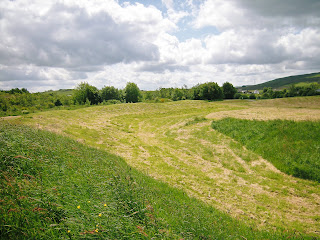
At least 2800 years old and it’s still scarcely on the map: an earthwork, bereft of fallen megaliths; a grassy entrance between modestly-raised grass furrows, a grassy exit. And yet a scene to wonder at.

They have it all at the more famous Arbor Low, and many more visitors, dropping a pound in a box before passing through a farmyard and to a site both ancient and famous; yet somehow a location steeped in loneliness.

One comes away with the wrong impression, for both Arbor Low and The Bull Ring were meeting places, and probably for hundreds of people, decade after decade, century after century.

Where did it all go?
Today, we have no time. Today, when people meet, they’re as likely to say, ‘Doesn’t time fly?’ as commune about the weather. Time – where did it go? What’s left of time is a chorus of ‘If onlys’. But not for the ancients assembling at the henge sites (there are scores of them in Derbyshire alone).

We know practically nothing about these sites, who actually used them, what they used them for, whether they were for worship or mainly communal gatherings, ancient equivalents of Appleby or Glastonbury. Was there music; were there games, buying and selling, parleys with sun, moon and stars?

Yet while the Bull Ring offers us less than Arbor Low in terms of furniture, its location gives us more clues. Its circular mound, with evidence of an outer rim, is more spacious than Arbor Low. The solitary tree in its centre has no ancient lineage; what counts, though, is what surrounds the Ring – a living community, and thereby ancient and modern connect.

The circular mound, with evidence of an outer rim, is still distinctive, though the mounds would have been higher and the ditches deeper. What the site was like has to be left to the imagination, for since it was abandoned there have been enclosures, the creation of a cemetery and the layout of football pitches.

Unlike Arbor Low, the Bull Ring remains a centre of community activity complete with a primary school and a children’s playground. And it’s to this Late Neolithic to Early Bronze Age location that folks from miles around gather to watch the fireworks – the stars and planets and rockets bursting into the sky, sharing pleasure, experiencing a sense of awe.

I was reminded of the travellers congregating at Appleby, and the crowds gathering at Glastonbury, coming together for ritual, for social pleasure. In contrast Arbor Low is isolated, with a farm close by, but otherwise a lonely and abandoned outpost; disconnected yet no doubt once drawing thousands for purposes similar to these at the Bull Ring over hundreds of years.

Quietness that deceives
The modern visitor relishes the silence, the abandonedness, the contrast with the bustle of life in towns and cities, yet there is something of anachronism about the preference. As Mark Edmonds and Tim Seaborne say in Prehistory in the Peak (UK: Tempus, 2001), ‘far from being places of “quiet solitude” that we now seek to conserve, Arbor Low and the Bull Ring were sometimes alive with people’.


The authors write of a 'confusion of camps and animals in the environs; people moving in and out of clearings and approaching along different paths. The mess of building gangs or companies gathered around fires; cooking, eating, talking. And then, when the time was right, an order amongst the multitude; people taking their places to participate or to watch proceedings in the henge itself. A broad social geography mapped to a tight scale'.

What the authors refer to as ‘the shock of the multitude’ is compounded by the difficulty we have in imagining how these henges were built. The ditches would have been deeper and steeper, the banks possibly three metres above the ground surface – altogether more formidable, suggesting purposes beyond that of assembly. The mounds would serve as a ‘steep and dramatic barrier that fostered a sense of containment’, hinting at exclusion as well as inclusion: ‘Children would not have rolled down the slopes as they do today.'

Questions concerning leadership, control, social hierarchy, privilege and authority will go on being debated, especially whether these were memorials to heroes, gods or spirits. Edmonds and Seaborne are wary of such conjectures, for ‘to see henges only as monuments to leaders misses the broader and more varied purposes they served in bringing dispersed communities together’.

Multiple purposes
Nevertheless, whatever the many functions of henges there is high probability that they had something to do with the dead, with the ancestors of the tribe; and that the purpose of large gatherings was reunion, of communion with the spirits of the dead – not unlike the way the Chinese picnic beside the graves of the deceased.

According to the authors of Prehistory in the Peak the ceremonies that might have taken place at the henges ‘tied the flux of the present to tradition, and tradition in turn to the timeless'; all this set against ‘a backdrop of communal events’ suggesting that ‘participation in rituals renewed ties between people’ while at the same time, perhaps, honouring ‘the standing of particular individuals’.

All-flux
It is this sense of framing and contrast, of the constant changes of the present day with a ritualised, and thus treasured, past that probably fascinates us most as we explore the sites of antiquity. We have minimal or modest fact to rely on, consequently we are left space not only to imagine who these ancestors were and what they did here, but to empathise with them; wondering, perhaps, what lessons the present might learn from the past.

My visit to The Bull ring inspired the following:


CONTINUITIES

Appleby is where the travellers meet
As compulsively as migrant birds
Flock to foreign shores, driven
By the seasons, and past habits;
To the rational mind beyond all reason.

The scholars surmise such gatherings
Were witnessed across millennia.
At Arbor Low, its concentric rings home
To standing stones anchored in earth
Signalling a long journey’s end,
The prize of community awaited,
The blessing of renewal, the promise
Of encounters old and new.

The bleakness here waylays witness,
Misleads with its sparse emptiness,
Its tune of silence imposed by mystery.
For this site probably teemed with assembly,
With music and gossip, tall tales and laughter,
A place neither still nor calm nor even holy;
But a goose fair, pop festival, highland fling,
An assertion and confirmation of origin,
Breed, race, tribe, restoring patterns of us and we,
Refurbishing the spirit of belonging.

While Arbor Low speaks poetry but no people
The Bull Ring a day’s hike to the north, nestles
Within the limestone village of Dove Holes;
Again the circles, the grassy banks, the sense
Of waiting; yet here continuity stands out
As prominently as the megaliths of Arbor Low –
The playtime voices from the school yard; kids
On the merry-go-round, the climbing frame,
The Saturday cajolings from the soccer pitch.

Here fondly and without ritual, ancient and modern
Are accommodated to the point where
The walker and her dog shows hesitant recognition
Of the earthworks under her feet, no notion
Of the tread of others down the centuries, where or why
They came, but at least with this knowledge
That on days of celebration, there are fireworks here;
The crowds are something to see, gasping in delight,
In childlike awe at fire, cascade and fountain
Exploding in the dark memory of the sky.

As we pause at such meeting places, we sense
The flicker of recognition, and possibly of regret
That what must have been a constant gradually
Or swiftly, we do not know, ended, to be replaced
By other cultures; by hierarchies favouring
Property over access, the power of privilege
To bar passage to what once was communal ground.

We see the face of the past in many disguises,
Often little realising that as we enact the present
We re-enact the past; walk the same ancestral paths,
Resist in our unique ways those driven appetites
For change, improvement, betterment, profit,
That the ancestors of those who became masters
Nurture for their own interests and comfort:
History is re-defined, curtailed as heritage.
If we step off the roped path we are guilty of trespass.

Our possibilities now are largely substitutes:
We join the crowd, do Glastonbury, stop to snap
A bikers’ reunion; more quietly strive
To piece together the mysteries of hallowed sites,
And sometimes imitate the rituals we guess
Celebrated sojourn and solstice, solemnly
Noting that here the dead, enticed with gifts,
Asserted their right of presence and inclusion.

As with the Chinese gathering each decade on Tap Mun
For the Festival of Peace, combining thanks and praise
To Tin Hau, goddess of the sea, with family picnics
Beside the graves of their dear departed, honouring
The space of those who failed to make the journey,
Introducing them to those arriving, those to come.

Whether at Arbor or the Bull Ring, Gibs Hill,
Hay Top, Withery Low or Gardom’s Edge
The visitor can expect a moment of reverence
But also of regret, as though discovering
A sudden loss; a feeling of having missed
An appointment with someone precious;
The same, perhaps, experienced aeons ago
By those gladly closing in on their destination
Only to count and mourn the missing faces.


NOTES IN PASSING
From the Writer’s Notebooks
March 2009

Picasso: Challenging the Past was, on its first day out at the National Gallery, packed. I wonder how many felt numerous questions arise about a genius of prodigious energy spending so much time mining the past, for I wasn’t convinced ‘challenging’ was the right term.

Much of the work is, or borders upon, caricature. The pleasure of recognition is obvious and one is intrigued at what Picasso actually does with masters of the past; and the range, from Ingres back to Velasquez. He matches Ingres for sheer painterly bravura; but Velasquez remains so infinitely superior.

The homage is there and welcome, but why did he do it? The exhibition organisers seem reluctant to go beyond their own awe and admiration. My own favourite was not really reworking the past: it was him, Picasso, his Cubist portrait of a woman. Yes, the derivation is rightly claimed to be Cezanne, perhaps the first ‘cubist’. But this did not represent a play on Cezanne, rather a development from him. Here Picasso builds on the art of the past rather than exploits it (however pleasurably).

Just another Nabonidas
So many of these big and expensive exhibitions, like Babylon at the British Museum which I toured today, would be so much better if they were simply in book form. The items on display are small; often hieroglyphics on stone letter scrolls; and the print instructions gather so many people round them that one’s tempted to skip… At least it was interesting to learn that with his tormented Nebuchadnezzar Billy Blake got it wrong.

Nebs it would seem never went down on his knees with torment and madness. It was a later Babylonian monarch, Nabonidas, who, like King Tut, attempted meddlesome changes to religion; in his case switching allegiance from Marduk to the Moon God, and paying a price of condemnation and dismissal.

Apologies it would seem are due to Nebuchadnezzar. What, however, was especially memorable was the epilogue to the exhibition – photos of post 2003 invasion Babylon, the site occupied by a Yankee military camp: you destroy a country, it follows that you trample on its history.

To be fair, Saddam had already re-cast himself as the hero of Babylon and built his own palace in the grounds of the ancient city. Just another Nabonidas.

Moral: beware of tampering with the gods; or the Yanks.

For King and Country
Just a reminder of something I heard on radio: how the US, UK and France excluded black soldiers from the Liberation of Paris parade in 1944; at the same time as some British general issued instructions that black GIs should not be invited to people’s homes.


The general wrote in a memo that while there was a minority of normally educated negroes, the majority of them were simple and unsophisticated. I suppose the same sentiments would equally have applied to the Tommies, the British working class, reflecting an attitude that had come down the class divide for centuries. 6 April 2009.

Thanks for reading this!
Why not write something for inclusion in the Watsonworksblog? Currently it is issued monthly around the 10th of the month.


Thursday, 12 August 2010

NOT JUST A BUNCH OF CHOCOLATEERS...


James Watson
Watsonworks
Blog 14

*What’s it about the Belgians?
* Hardy & Chekhov: happy endings?
* Lest We Forget… Gaza, the pusillanimous West
* ‘Snaps’ & ‘Tom Thumbs’


What's it about the Belgians?
No one seems to have much of a good word for the Belgians so I’m glad to report on a book that does them proud. The Twentieth Train, by German journalist Marion Schreiber, is an account of the Nazi occupation of Belgium and the persecution of the Jews; the key focus being the determination of the SS etc. to get the Jews on to trains heading for Auschwitz.

The 20th train was the one – the only one – in which escape took place, resulting from the hi-jack action by three Belgian friends armed only with pairs of pliars, a hurricane lamp covered in red paper and one pistol between them. The train was halted, a skirmish followed and 225 prisoners managed to escape.
The book matches any thriller, the events being described in the kind of detail which allows the reader to dramatically and movingly realise the wider picture.

In fact, the book devotes only a chapter or so to the ambush of the train – successful for many on board, disaster for others, including the leader of the tiny guerrilla band. The rest of the book focuses on the build-up to the attack, taking in the many connected people among the Jewish and non-Jewish community.

Protecting the hunted
What is so much to the credit of both Jews and non-Jews in Belgium is the respect that was shared, the very real (and dangerous) protection the non-Jewish extended to the Jews under the manic eyes of the Nazis. Families were hidden. Children separated from arrested parents were ‘adopted’. Time and time again Belgians risked their lives to protect the hunted.

Of course there were SS stooges who, to curry favour with the Germans, wormed their way into the confidence of Jews and then betrayed them; men such as the elegant and charming Pierre Romanovitch, the self-styled ‘Russian count’.

The leader of the ambush of the 20th Train, Doctor Youra Livichitz, having survived that fateful night of 19th April 1943, having so successfully kept the enterprise secret, relaxed his guard. Putting his trust in the apparently honest Romanovitch, he let slip the names of those needing help; and for that misjudgement paid the ultimate price. He was arrested, tortured and shot – as his brother, and fellow conspirator, had been.

It is a traumatic as well as a moving and inspiring story. Those that escaped were but a tiny fraction of those who completed their journey to Auschwitz and the gas chambers. But Schreiber’s excellent and important record of events pays due regard to the courage and resolution of ordinary Belgians during these horrific times; something folks should remember when a nation is classified as little more than a bunch of chocolateers.


Notes in passing…1
From the Writer’s Notebooks

Hardy, Chekhov & happy endings
Even in his short stories, Thomas Hardy sets Destiny against happy endings. While Chekhov’s Lady with the Little Dog does not exactly end happily, it does not end sadly; indeed though the affair between Gurov and Anna will continue to be troubled, because it has to be kept secret, it suggests there will be no end; that true love will overcome circumstances.

The same would probably happen in Hardy’s stories, but there is always the invisible hand of fate unwilling to permit happiness or true deserts.
Chekhov focuses on the human predicament of fate, nevertheless, in that both lovers are married to people they do might have been the opportunity to commit to love without concealment.

Love as identified in the Chekhov story is difficult to define, to pin down, and the characteristics which induce love in the first place are unclear. What is it about Gurov that makes Anna love him? He is twice her age, greying. In turn we learn very little about what he sees in her except her beauty, for her sense of guilt at the affair, of being a sinner, is not a feature that draws him closer; on the contrary.

So we are left with a mystery, though it might be asked whether the need for secrecy, the risks that are being taken, the on-the-edge nature of the affair is the spice which, for both of them, gives the relationship its frisson.

Notes in passing…2
From the Writer’s Notebooks

4th Jan. 2009: Another year, another protest
Having practically choked Gaza to death, Israel has now been bombing it for days. Last night they invaded. Meanwhile between London’s Embankment and Trafalgar Square thousands of us protested, in bright sunshine surrounded by an ocean of banners.

It may do us good, the marchers; make us feel that we are achieving something, but as with the million-strong march against the invasion of Iraq, we were powerless, probably even pathetic.

The war went on because those in power willed it, were in collusion. As always the odd man out was Joe Public. Of course the New Labour government’s response has been pusillanimous – oh, the grave concern of it, the wringing of hands; but as for doing something about the situation, nothing.

Politicians keep using the word ‘disproportionate’. When a rocket from Hamas takes one life in Tel Aviv and Israeli bombs kill a whole mosque full of worshippers, that is disproportionate.

What does that bloody-well mean? Not fair; not just; not playing the game? And yet, under media interrogation the foreign secretary, Mr. Arsole Miliband, refuses actually to speak a word. Oh yes, it has been collectively expressed at the United Nations – but for a minister of the Crown to say it out loud, no.
Of the many placards the one that took my eye said:

GUERNICA
WARSAW
GAZA
ISRAEL STOP BEHAVING
LIKE NAZIS

‘Snaps’ & ‘Tom Thumbs’
Visitors to the excellent blog of Sarah Salway (Sarah Salway’s Writing Journal) will have become familiar with her short stories of 50 words, the triggers for these being odd or intriguing snapshots. I’ve been doing something similar only (so far) without the snaps and with a more indulgent word-count of 100, or fewer. These tiny tales I’ve called Tom Thumbs. Who knows, Snaps and Tom Thumbs might catch on – an annual festival, maybe…

To round off this blog, here’s one that abides by Sarah’s rule of 50 words:

Two’s a crowd
The world’s greatest faced each other across the Signoria. ‘After you, Maestro,’ said Michelangelo.
‘No, after you,’ replied Leonardo.
You’ll need longer,’ argued Michelangelo.
Leonardo: ‘I’ll wait till you have a decent wash.’
Without adding a brushstroke they went their separate ways. A lesser painter, one Vasari, spared Florence’s blushes.

Thanks for reading this. As ever, feedback welcome.
JIM.

Wednesday, 14 July 2010

WATSONWORKS Blog 13


A BLOG ON
BLOGGING
Point and Purposes

The Internet made the blog possible, but it did not invent it.
Once upon a time when printing and publishing were cheap writers could express themselves in many different forms. As well as the long stuff, they produced essays, papers, edited newspapers and magazines.

Jill Walker Rettberg in her recent book, Blogging (1) claims that the French novelist Alexandre Dumas was the first blogger: ‘he was truly into the new technology of the modern press, introduced in France in the 1830s. Dumas’ first newspaper was written solely by himself, and was called Le Mois, with a tagline that sounds so bloggish it must be in use by some blogger, somewhere: jour par jour, heure par heure (‘day by day, hour by hour’)’.

Dodging the crush
Contemporary writers have, until the last decade, depended in one way or another on the mass media to open doors to their publications, short or long. Such has been the competition for access that inevitably queues form as fortunes rise and fall and as new kids come rolling or skateboarding on to the block.

Agents have queues at their door; publishers have slush-piles of unread scripts. The BBC Scriptwriters grant a ten minute window for every submitted script; what doesn’t impress in that time goes back into the stamped-addressed envelope.

Fees apart, fat or thin, that scenario prevails in the markets for mass media and mass consumption. The Internet, however, has opened other doors. Would-be writers, or established ones, are no longer limited, as broadcasters have been, to ‘wavelength rationing’. They don’t have to line up for judgment, largely by people they’ve never met and are unlikely ever to meet as big publishing companies swallow up smaller, more intimate and often more supportive ones.

Today, one has an idea for a story, a play, an article, an essay, a poem, even a haiku, and one can post it for the world to read, free of intermediaries. The writer is liberated from gatekeeping.

True, though there are ways of checking the numbers out there who key in to the uploaded texts, the writer can rarely be sure that the readers have sustained their interest, read a sentence, a paragraph or the whole piece. That, of course, is also true of texts in print: who’s reading your book, in what way, and to what (if any) effect?

What blogging on the Internet does allow, makes easy and indeed purposeful, is feedback. Uploaded texts can prompt discourse between author and reader which one-way print media or traditional radio or TV broadcasting rarely can.

Quality control?
Resistance to the notion and practice of blogging is an offshoot of a long tradition concerned with standards. Unless you’ve gone through the mill, how dare you seek to bypass those who police quality? The trouble with standards and quality is that they fluctuate and often defy accurate or even fair definition.

Culture is as much about restricting entry as nurturing it; like so much education, it serves to favour the few over the many. It views talent as essentially a restricted commodity, both highly selective and exclusive.

There are good reasons for careful scrutiny of, for instance, citizen journalism; after all, journalism is a respected trade, requiring many skills and ideally preparatory training and experience. Yet few bloggers aspire to be ‘professional’ in the traditional sense of journalism, and very few, if any, have ambition to replace those trained, practised and professionally committed to journalism.

Uneasiness about citizens ‘intruding’ on the patch of media professionals centres less on standards than on economics. As in most other businesses, employers are constantly on the lookout for cost cutting in a labour-centred industry – why pay a professional photographer, for example, if amateurs are happy to get their snaps in the paper for little or nothing?

Yet it is not bloggers who are shutting down papers but competition in and between traditional media industries. A solid case can be made for saying that Internet communication has benefited mass media. A scan of the press indicates an already well established synergy between traditional media and blogging. Newspapers dedicate columns and sometimes whole pages to the comments of bloggers on particular topics in the news. They do it for liveliness, originality and brevity.

A vital role
Further, it is important to recognise and celebrate examples of the way bloggers contribute to our knowledge of what is going on in the world. Reports by Salam Pax from Baghdad during the war in Iraq were individual in transmission and content, but of global interest – because they were issuing from the epicentre of events.

Salam Pax was in no position to report – as professional journalists would be expected to do – ‘objectively’, but the personal in this case was what was so valuable and unique.

Such citizen postings will increase as online readership searches for information, news and views which escape the mediation characteristic of traditional media ownership and control.

While expecting objectivity from blogs is to mistake their nature, other principles that apply to serious mass media reporting should be equally honoured and observed. Bloggers often function as anonymously as Salam Pax, for similar or different reasons, but there are quicksands ahead for those who set out to deceive their audience.

Principles of performance
Sooner or later scams get found out and the backlash can be devastating. Narratives that purport to be real such as the video blog Lonelygirl15 which turned out to be a fiction, scripted and acted out by professionals, invite rejection, censure and disillusionment.

The freedom to be anybody on the Internet inevitably blurs the
line between truth and fiction and between what’s real and what is simulation or simply PR. Trevor Cook in ‘Can Blogging Unspin PR?’ published in Uses of Blogs (2) believes that bloggers, professionals or otherwise, need to maintain trust by affirming ‘fairness, balance, accuracy and integrity’.

Thus if you’re earning a few pounds, dollars or euros from product sponsors, then you must come clean about that sponsorship. Even on the Internet there is no such thing as a free lunch. For most of us, though, blogging is free because we are not reliant on income to finance our messaging.

A ‘common possession’; but for how long?
What bloggers are reliant on is a free field of delivery and access. There have long been fears that cyberspace will prove to be less of an open prairie than it used to be.

Currently, what the late Roger Silverstone in Media and Morality: On the Rise of the Mediapolis (3) refers to as the ‘otherwise invisible and unheard’ and the blog as ‘a phenomenon to contest the already weakening stranglehold of the national press and broadcasting systems’ remains ‘a platform for public participation’.

Silverstone sees this alternative to mass communication as ‘a common possession’. He envisions a mediapolis characterised by justice and what he refers to as ‘hospitality’ – openness, the acceptance and welcoming of Other, equality of exchange; but he also states his uneasiness about a situation that is ‘constantly at risk both of its own self-violation (paedophile and terrorist networks) and its enclosure (by transnational corporations and political controls)’.

What has scared Netizens in recent years is the threat to network neutrality. In a Washingtonpost.com article (4), media analysts Lawrence Lessig and Robert W. McChesney wrote that network neutrality ‘means simply that all Internet content must be treated alike and move at the same speed over the network. The owners of the Internet’s wires cannot discriminate’.

Pressure to legislate for precedence
Lessig and McChesney’s article is entitled ‘No Tolls on the Internet’. They write that network owners ‘could slow down or even block the websites and services of their competitors…Without net neutrality, the Internet would start to look like cable TV. A handful of massive companies would control access and distribution of content, deciding what you get to see and how much it cost’.

The authors refer to the ‘smell of windfall profits in the air in Washington’ as the phone companies ‘are pulling out all the stops to legislate themselves monopoly power’.

Blog battlers
Alerted to this corporate threat to their futures, bloggers by the thousand, aided by over 700 Internet groups, successfully pressurised the American Senate Commerce Committee into approving the AT & T merger with BellSouth in June 2006 on condition that network neutrality was preserved.

The New York Times commended this ‘limited but important victory for net neutrality’ but added that ‘it should not be necessary to negotiate separate deals like this one’. Net neutrality remains, but so do the ambitions of the corporate sector. As the New York Times asserted, ‘On the information superhighway, net neutrality should be a basic rule of the road’.

Loose wheels on the big-buck tumbrils
Corporate Man has never been hesitant to follow the rule If You Can’t Beat Them, Join Them. How many global Internet sites are not in the hands of the big spenders? MySpace passed into the ownership of Rupert Murdoch in 2005 for an estimated £200m.

In the following October Google snapped up YouTube; while Facebook, with its millions of ‘friends’, has been described by journalist Tom Hodgkinson as an ‘extension of the American imperialist programme crossed with a massive information-gathering tool’ and which is commoditising human relationships; success, it would seem, guaranteed (5).

Yet a prevailing feature of the Internet is uncertainty. What goes up usually comes down, and often with a sudden bump; even the media masters get their fingers burnt. Hundreds of jobs have been lost at MySpace. In June 2010 AOL sold Bebo for a sum dramatically less than it paid for it.

David Teather writing on social networking (6) talks of ‘soured investments’: ‘Ever developing applications and a lack of customer loyalty mean social networking can become huge, almost overnight, and crash just as quickly’.

Keep up the sharing
But to close on an up-note: enthusiastic student of, practitioner and advocate of blogging, Jill Walker Rettberg declares in Blogging, ‘People like participating in the media. We like contributing and sharing our ideas, and we’re unlikely to stop now that we have the technology to allow it’.

She goes on, ‘Participatory media which makes publishing available to everyone is like fire: once the cunning Prometheus had stolen the secret of fire from Zeus and given it to us mortals, there was no way for the gods to take it back’.

Rettburg receives ample support from Net guru Clay Shirky interviewed in the UK Guardian by Decca Aitkenhead (7). He argues that those who post – free of charge – their thoughts, views, knowledge, opinions on the Net do so because it satisfies ‘the primal human urge for creativity and connectedness’.

Compared to traditional media such as the press and TV, Shirky says the Internet ‘has removed the barrier to universal participation and revealed that human beings would rather be creating and sharing than passively consuming what a privileged elite think they should watch’.

Islands of civil discourse
This is a hearteningly optimistic point of view, but would need to be considered alongside Decca Aitkenhead’s more sceptical position, ‘bewildered’ as she is ‘by the exhibitionism of online social networking’, its ‘juvenile vacuity’, ‘baffled by the amount of time devoted to posting photos of cats that look amusingly like Hitler’ and ‘a little bit dismayed by Facebook’s revelation of almost infinite narcissism’.

Shirky’s answer is that ‘even the stupidest possible creative act is still a creative act. And I’d still take the most inane collaborative website over someone watching yet another half hour of TV’. In other words, don’t blame the medium for the message!

Along with other commentators, Shirky recognises that while anonymity can make people ‘behave more meanly’, he remains confident that ‘we are slowly going to set up islands of civil discourse’. His message is, be yourself: ‘We need to set up the social norms which say in this space you need to use your real names, or some well-known handle’. He sees ‘the really big challenge’ is how to maximise the Net’s ‘civic value’.


NOTES
(1) Jill Walker Rettberg, Blogging (Polity Press, 2010).
(2) Trevor Cook, ‘Can Blogging Unspin PR?’ in Uses of Blogs (Peter Long, 2006), edited by Axel Bruns and Joanne Jacobs.
(3) Roger Silverstone, Media and Morality: On the Rise of the Mediapolis (Polity Press, 2007).
(4) Lawrence Lessig and Robert W.McChesney, ‘No Tolls on the Internet’, Washingtonpost.com, 13 June 2006.
(5) Tom Hodgkinson, ‘With friends like these…’ Guardian (14 January, 2008).
(6) David Teather, ‘Social networking curse strikes again as Bebo is sold’, Guardian, 21 June 2010.
(7) G2 ‘If there’s a screen to worry about in your house, it’s not the one with the mouse attached’, Clay Shirky talks to Decca Aitkenhead, 5 July, 2010. See Shirky’s Cognitive Surplus: Creativity and Generosity in a Connected Age (Allen Lane, 2010).


********************************

The author is currently working on the 8th edition of The Dictionary of Media and Communication Studies (with Anne Hill).
Thanks for reading this. Feedback welcome as usual.
JIM.

Wednesday, 16 June 2010

BRINGING WRITERS BACK FROM THE DEAD


LEST WE FORGET:
The Power of Biography

James Watson
Watsonworks
Blog 12

Blog: A mode of Internet communication expressing the author’s interests, preoccupations, opinions and biography, to a known and sometimes unknown audience; with potential for interactivity.

Review……………………………………………

Michael Scammell, Koestler:The Indispensable Intellectual (Faber and Faber, 2010).

Prescient in almost all his judgments – on politics, history, literature and science – Arthur Koestler (1905-83) wrote in his diary ‘Every writer is forgotten after his death’. Plenty of people, even dedicated readers, might be forgiven for never having sampled Koestler’s vast and diverse output, and at best having the vaguest notion of who Koestler was or why he should be remembered.

Michael Scammell’s 689-page biography should restore Koestler to the pantheon of literary celebrity, not only because Koestler had much to say that still has relevance and interest but because of the amazing times he lived in. While reading about Koestler’s life one is reminded of the Chinese philosopher, faced with wars, famines and more wars, prayed that he might ‘live in uninteresting times’.

Running for his life
A Hungarian Jew, Koestler had scarcely emerged from his teens before he was in the thick of it. A bold and resourceful journalist he reported from the Spanish Civil War, was arrested by the Fascists, imprisoned and was a hair’s breadth from being executed.
Caught in Germany as Nazism ceased its pretentions to parliamentary rule, Koestler was once more on the run.

Desperate and remembering how in a film he had seen Jean Gabin escape a police hunt by joining the French Foreign Legion, Koestler, needing to disguise his Jewish origins, took the name of the Limoges police chief, Albert Dubert, and briefly became a Legionnaire. The rest of this tale can be followed in Chapter 16, Darkness Invisible.

The UK authorites, in particular M15, were slow in offering Koestler asylum. His record as a Communist activist (even though he had rejected Stalinism) led to his incarceration as a dangerous alien. It was probably only because of his well-placed friends – chiefly the literati – that he was not subjected to prolonged imprisonment during the 2nd World War. He escaped a life behind bars by signing up with the aliens’ Pioneer Corps (whose emblem was a crossed pick and shovel).

Koestler saw service in Ilfracombe and Cheltenham, largely digging tank trap holes before, in March 1942, being written off as ‘permanently unfit’ for service. Later in the war he worked as an air-raid warden and an ambulance driver.

Controversy: second nature
In his Prologue to Koestler, Michael Scammell writes that ‘Provocation and controversy were meat and drink to Koestler, elements of a tumultuous life in which he rarely experienced peace or quiet…Hungarian in his temper, German in his industry, Jewish in his intellectual ambition, he was never comfortable in his own skin’.

It was evident to those who knew him well that, despite his achievement and his fame, he suffered from self-doubt, ‘an undisguised vulnerability and painful honesty, a self-conscious shyness and morbid sensitivity’. This, ‘combined with his boyish exuberance and devil-may-care daring made him a magnet for innumerable women’.

Details of Koestler’s contribution to and involvement with historical events of the 1930s, 40s, 50s and 60s are for the reader to discover. However, what particularly warrants recognition is Koestler’s energetic campaigning as writer and activist against Capital Punishment in Britain.

Implacable opposition
During his imprisonment during the Spanish Civil War, 17 of his fellow prisoners in Seville jail had been shot to mark the anniversary of the proclamation of the Spanish Republic. Among them was 19-year Nicolas who Koestler had befriended during periods of exercise. He was later to dedicate Dialogue with Death to Nicolas.

It was from these experiences, writes Scammell, that Koestler’s ‘implacable opposition to capital punishment was born’ and led to the publication of his influential Reflections on Hanging. Koestler was also to demonstrate a lifelong sympathy for the imprisoned. He set up and financed annual awards for prisoners who demonstrated creativity in the arts – a scheme that continues to this day to reward endeavour in the visual arts and literature.

Animating the past
Koestler the man warrants the description ‘prodigious’ as indeed does the biography, Koestler. The product of ten years research and preparation it succeeds Scammell’s equally epical, Solzhenitsyn (1051 pages, Hutchinson, 1984). What we get in both cases is an immensely detailed historical tapestry. With the protagonist at its centre, the past is suddenly happening again, the reader being carried along as though actually involved in events.

A graduate in Russian from Nottingham University, translator of several books from Russian and Serbo-Croat, the founding editor of Index on Censorship magazine, now a professor at Columbia University, Michael Scammell conducted upward of two hundred interviews with Koestler’s friends, relatives and professional colleagues.

His Notes alone cover some 80-odd pages and he travelled in 14 countries in three continents in pursuit of one who had first sprung to fame after reporting on the first flight of the Graf Zeppelin from Berlin to the North Pole in 1931.

Dynamic but overstretched?
In one communicative form or another, Koestler, writes his biographer, ‘investigated a multitude of political movements, religions and scientific disciplines, from Zionism to Catholicism and even Buddhism, from anti-fascism to communism and anti-communism, from astronomy and evolution to neurobiology and parapsychology’.

Notoriously, and with little approval, Koestler allowed himself to be lured into the terrain of ESP (Extra-Sensory Perception), professing himself horrified at the prospect of coming out publicly in support of it, ‘fearing and relishing the risk, and feeling that having come so far, it would be cowardice not to follow his instincts’ (See Scammell’s Chapter forty-six, Chance Governs All).

The danger, as Scammell points out, has been an ‘inevitable unevenness’: Koestler could be accused of writing ‘too much in too many genres’ – novels, essays, biographies, scientific speculation.

Yet Koestler’s second novel, Darkness at Noon, published in 1940, has never been out of print and though his other novels may ‘seem rather dated now’ – The Gladiators, Arrival and Departure, Thieves in the Night and The Age of Longing – ‘each has passages of imaginative power and intellectual brilliance’; while his science books such as The Sleepwalkers ‘brought both a storyteller’s eloquence and characteristic activism, for his urge is there, as in all his fiction and nonfiction, not just to describe the world, but also to change it’.

Ambiguities
Scammell deals frankly and fairly with Koestler’s reputation as a womaniser. In his many relationships with women Koestler was ‘an egotistical, mercurial, and unpredictable perfectionist…whose demands knew no bounds’. He was ‘too hard on his women (and on himself)’. While they were ‘far from infantile Cinderellas…it was true he had met many of them at vulnerable moments in their lives and had harassed them and bullied them all into submission’.

A ‘stream of righteous abuse of Koestler that continues to the present day’ concerns the confession in 1998 by Jill Craigie, wife of Michael Foot, to another Koestler biographer, David Cesarini, that she had been raped by Koestler.

Scammell is of the view that there ‘are many ambiguities surrounding Cesarini’s (and Craigie’s) account of the incident. First of all, Craigie waited so long (nearly fifty years) to make her accusation public when Koestler was no longer alive to defend himself or ‘give his own version of this meeting’.

Scammell cites Koestler’s diary for that day: ‘Jill Foot –Sunday pub crawl on Heath’, and states, ‘Given that Koestler was gloatingly totting up his conquests in his diary at that very time, it’s surprising that he made no mention of having had sex with Craigie, unless he was so drunk he completely forgot about it’.

Craigie joined Michael Foot and Koestler for lunch at the House of Commons a week later, ‘and some twenty years after that, in 1975, she and Foot were guests at Koestler’s seventieth birthday party’. For further comment, see Chapter Thirty-Six, The Phantom Chase.

Despite Koestler’s domineering conduct towards the women in his life, his second wife, Mamaine, found him, in her own words, ‘as angelic as ever’, while his third wife, Cynthia, obedient servant to Koestler’s every whim, knew no doubts about a life without him. He was 77 and in ailing health. Still only in her 50s, she shared his preparations for suicide and chose death rather than be without him.

More to come?
Closing this massive, complex and elegantly written biography, readers will be left with an appetite for more, in particular from Koestler’s actual texts. His publishers should persuade Michael Scammell to assemble a companion volume to Koestler, an anthology of those bits across the author’s oeuvre that possess ‘imaginative power and intellectual brilliance’.

In his Prologue to Koestler: The Indispensable Intellectual, Scammell writes that he was ‘a romantic whose quixotic hopes that some variant of the utopian dream might lead to happiness on earth were constantly being shadowed and undercut by a pessimistic acknowledgment of the realities of human nature’.

His ‘quest for enlightenment was not some arid, abstract sort of research, but a deep instinctual urge, powered by personal unhappiness and psychological frustration, which started early in his life and continued to the very end of his days’. In this sense, Koestler was ‘emblematic of the twentieth century’s own flailings in the search for a workable form of utopia’.

Notable works by Koestler: Arrival and Departure, Darkness at Noon, Thieves in the Night, Scum of the Earth, Promise and Fulfilment, The Age of Longing, Reflections on Hanging, The Sleepwalkers, The Lotus and the Robot, The Act of Creation, The Ghost in the Machine, The Case of the Midwife Toad, The Roots of Coincidence, The Challenge of Chance, The Thirteenth Tribe, Janus, From Bricks to Babel (an anthology).

Further information can be found at the author’s website,
http://www.michaelscammell.com/; and feedback to Watsonworksblog.blogspot.com is of course welcome.


***********************


BLOG LISTING

Blog 1
3 September 2009

Introduces FAIR GAME: THE STEPS OF ODESSA
(Spire Publishing, ISBN 1-897312-72-5), a human rights novel for Young Adults; a story about the struggles of Natasha, a talented young footballer in Ukraine. Her journalist father is on the run for revelations he has made about government corruption: the consequences for Natasha and her brother Lonya are not only career-threatening, but life-threatening.

To further complicate things, there is Natasha’s friendship with Monika who, on the face of it, is a tour guide, but what secret is she keeping about her and her family; and how has she come to be in possession of the Pushkin Ring that went missing from a Moscow Museum during the Russian Revolution?

The story heads for a dramatic climax on the Steps of Odessa made famous by the massacre scene in Sergei Eistenstein’s film masterpiece, Battleship Potemkin: could something similar happen on those steps that ‘seem to reach to the sky’?


Blog 2
15 September 2009
Introduces the BUXTEHUDER BULLE PRIZE awarded annually for Young Adult novels on human rights themes and judged by young German readers. The author’s Talking in Whispers was a winner and he was invited to Buxtehude near Hamburg to receive the prize.

I was so delighted by this old Hanseatic town with its canal (and its noisy ducks), that I wrote a children’s story, The Noisy Ducks of Buxtehude (later published in a dual-language version by Verlag an der Est, ISBN 3-926616-90-3). This blog gives an account of ‘a quacking tale’ translated into German by Heike Brandt and illustrated by Bjorn Holm.

Blog 3
29 September 2009
THE TROUBLE WITH MONUMENTS. In Ukraine’s capital, Kiev, there is Babi Yar, site of the barbarous executions perpetrated by the Nazis, and collaborators, during World War 2, a sacred site of immense symbolic importance. With the prospect of international football coming to Ukraine, there were those on the city council who wanted to build new hotels close to and overlooking the site. This blog protests about the proposal; which thankfully was rejected by the Kiev city council.
In contrast, in Senegal, one of the world’s poorest countries, a 49 metre bronze statue now dominates the capital, Dakar. It glorifies at prodigious expense the hubris of those in power, a £17m assertion of elitism over equality.

Blog 4
23 October 2009
HISTORY’S NEGLECTED WOMEN. In researching for a play on the struggles for press freedom and democracy in 19th century Britain (Out Damned Spot!) I came to realise what a vital part women played in those struggles, and how they seem to have been written out of the records.

They worked as hawkers of the radical press, printers and writers, and their sufferings were equal to men’s in the pursuit of those struggles – crippling fines, imprisonment and in a few cases deportation.
Eliza Sharples, second wife of the combative editor, Richard Carlile, became a star, addressing packed audiences in London’s Rotunda, while her husband languished in jail. Act 4 of Out Damned Spot! focuses on Eliza, and is titled The Lady of the Rotunda.

Blog 5
10 November 2009
IN PRAISE OF WOMEN’S SOCCER. Research is an author’s archaeology. In preparing Fair Game: The Steps of Odessa I was startled to discover that once upon a time in the UK women’s football was immensely popular; women’s matches drew huge crowds.

Yet on 5 December 1921 the Football Association banned women from playing on FA-affiliated pitches. This blog looks at how women’s soccer has fought to reaffirm itself in Britain, and how football has become one of the paramount sporting interests of women and girls.

Blog 6
15 December 2009
LAST FLIGHT OF THE HEYFORD K 6875. In July 1938 a six-crew RAF Heyford hit a violent rainstorm in the Derbyshire peak district. Before the days of radar navigation, the plane was off course and dipping towards Edale. The Heyford’s design was such that it blocked the pilot’s view immediately in front and below.

Another 30 metres or so, and the plane would have avoided Broadlee Bank. Instead, the plan struck ground, and the crew were consumed in a fireball.
Among the crew was my Uncle, Jim Barker. A version of this account, a tribute to the dead, was published in Derbyshire Life magazine.

Blog 7
7 January 2010
This was the first of five postings on ASPECTS OF STORYTELLING. Part 1, TRIGGERS AND PROPS, opens with a look at how stories get started, what triggers interest and motivation, and how such triggers carry the story forward, from a major national or world event (like the military overthrow of democracy in Chile, triggering Talking in Whispers) to a fleeting snatch of conversation (such as a reference to a misspelt tattoo triggering The Great Tattoo in Make Your Move, and Other Stories).

Supplementing the main course of Blog 7, in Notes in Passing, another World War 2 disaster is described; a disaster which result from an officer’s arrogance in the face of good advice.

A newly-arrived squad of Canadians encamped above Cuckmere Haven in Sussex. There was a wonderful view of the sea. A local man warned the officer that his men were encamped under the flight path of German planes.

His men were a sitting target. The officer knew better than to take advice from a civilian. As predicted, the Messerschmitts came. They could not believe their luck. It was too late for the Canadian officer to change his mind.

Blog 8
15 February 2010
ASPECTS OF STORYTELLING
Part 2: PROPS PROPEL
Following on from Blog 7, a look at the role played by props in narrative, from Cinderella’s glass slipper to the jewelled pendant worn by Madeleine in Alfred Hitchcock’s Vertigo, from the Pushkin Ring that serves to animate a sub-plot in Fair Game: The Steps of Odessa to the Michael Jackson T-shirt that proves Eloise, in The Ghosts of Izieu, does not belong in 1942.

The author’s childhood hobby, hand puppets and string marionettes finds a literary outcome in Talking in Whispers in which the twins, Isa and Beto, use their puppet, General Zuchero, to protest at tyranny.

Notes in passing… Gives the thumbs down to Avatar.

Blog 9
15 March 2010
ASPECTS OF STORYTELLING
Part 3: Frames, Codes and Character.
A look at the structures of stories, how they fit in to forms or genres. The narrative forms of soaps and sitcoms are compared, the templates that govern them and how symbols illuminate and guide them.

The five narrative codes posed by French philosopher Roland Barthes, expounded in his book S/Z, are examined – the Action Code, for example, being traditionally associated with male characters, the Enigma code with women; codes, of course, inviting the writer to reverse or overturn them.
Also introduced is the categorisation of characters by the Russian Vladimir Propp in his study of folk tales.

Blog 10
14 March 2010
ASPECTS OF STORYTELLING
Part 4: Fiction and News
This posting explores the interlink between fiction and news, both of them narratives with common objectives though differing formats. What’s happening in the real world, in the news, has always influenced the content and approach of fiction.

Just as there is newsworthiness so there is fictionworthiness; and what is newsworthy triggers fictionworthiness. On the other hand, sometimes what happens in the news is so strange or exotic that in fiction it would be regarded as failing to suspend the reader’s disbelief.

Feedback…from novelist Anna Perera, author of Guantanamo Boy (Penguin).

Blog 11
15 May 2010
ASPECTS OF STORYTELLING
Part 5: Tale Power
Humans are essentially storytelling animals. We live stories, they are part of us, individually and collectively. This posting investigates the power that stories have to influence us – our attitudes, opinions, our outlooks, our values and sometimes our behaviour.

Though some downsize the power of stories, classifying them as little more than entertainment, a scrutiny of censorship, present and past, will at least indicate that those in authority, those in power, are fearful of stories ‘getting a hold’ on people, particularly if stories threaten to influence large numbers.

A simple 17-syllable haiku in Burma can get you a five year prison sentence, never mind the endless stories of the persecution of authors down the ages, from Sophocles to Solzhenitsyn.
The posting concludes with questions on how the Internet, in the Age of Twitter, is affecting, and will affect tale power.

****************************************
FURTHER INFORMATION:
http://www.watsonworks.co.uk/

CONTACT: Watsonworks@hotmail.co.uk


Friday, 14 May 2010

THE POWER OF STORIES


Aspects of Storytelling
WATSONWORKS
blog 11 of author James Watson

*************************

Previous sorties into storytelling –
BLOG 7 – Triggers
BLOG 8 - Props
BLOG 9 – Frames, Codes and Characters
BLOG 10 –Fiction and News

Part 5:

TALE POWER

Stories not only influence us, they are part of us. In his book Narratives in Popular Culture, Media and Everyday Life (Sage, 1997), Arthur Asa Berger says that we ‘spend our lives immersed in narratives. Every day, we swim in a sea of stories and tales that we hear or read or listen to…from our earliest days to our deaths’. We are truly Homo Narrens, the storytelling animal.

Of course, we can’t be exact and we certainly can’t predict what stories will influence, whom and to what degree. Very often we have to judge the potential power of stories – to influence or change attitudes, and sometimes to influence and change behaviour – by the reaction to stories; by the behaviour of those who would censor those stories.

When the Roman Catholic church introduced the Index Librorum Prohibitorum they were seriously worried about the power of books. Authoritarianism in all its forms
fears what books can do; in fact it very often shows more respect for the potency of reading than perhaps it warrants. Nobody ever suggested that, for example, the bar should be raised on Jane Austen’s work, unless it was those worried about people idling their time away with ‘a good read’.

On the other hand, Tom Paine would have been hanged, drawn and quartered by the British ruling establishment if they had been able to lay hands on him for his scurrilous condemnation of monarchs and self-serving governments in The Rights of Man and other works.

Fear of the collective
Attempts to curtail tale power have only marginally anything to do with what readers get up to in their own homes.

Rather it is about stories that bring people out of their homes to join the company of others with questions to ask, demands on their lips. What the censors fear most is people power. When those responsible for publishing D.H. Lawrence’s Lady Chatterley’s Lover in paperback landed in court the target was not the book but the kind of people who might read it and be influenced by it; that is, what Edmund Burke one termed the ‘swinish multitude’.

Today those who rule us are more polite about these things: we are customers, sometimes citizens and the Official Secrets Act keeps the only really dangerous ‘tale power’ under lock and key.

Slow seeds fermenting
For most of us, reading remains a personal experience. What impresses us, we share with friends and family. If we are teachers, we spread the world a little farther. We not only wish to communicate the specifics of a story or stories, but transmit our enthusiasm for reading itself.
Little by little, personal enthusiasms are shared, passed along, passed down.

At this level we are considering personal empowerment, but it would be risky to underestimate the transition of acorn to mighty oak. Indeed every collective begins with individuals, minorities; every ideology that at first struggles to surface is the work of individuals.

Without St. Paul, where would Christianity be? Without Karl Marx would the most populous nation on earth be a Communist regime?

Story-Myth-Power
There are tales which so powerfully take hold that we can no longer control them. What begins as a narrative slowly or even suddenly becomes promoted to the level of myth. This takes the form of explanation, then hardens into definition finally graduating into an incontrovertible truth: one word for this is religion.

Those who might challenge that truth – a new generation of writers, for example, may find they are regarded as enemies and punished for daring to call Truth Myth.

As races, as nations, people seem to have a profound need for collective reassurance which is what stories are good at providing. American professor Ernest Borman has referred to what he calls ‘rhetorical fantasies’ that ‘fulfil a group psychological or rhetorical need’.

In the Journal of Communication Autumn 1985, Borman writes that when members of the mass share a fantasy, ‘they jointly experience the same emotions, develop common heroes and villains, celebrate certain actions as laudable, and interpret some aspect of their common experience in the same way’.

Ground prepared
1930s Nazism in Germany was delivered through propaganda but it seems to have been sown on receptive ground. There came a time when principles of democracy, tolerance, fair-play and justice tippled over into their opposites. Arianism, notions of white dominance, became the key narratives of the time, with variations at work in Italy and Spain.

How do you undo a ‘true’ story that has gathered up the power of myth and become the only story in town; the only tale the powerful will tolerate? One might suggest that honest history will do it combined with fearless journalism; but how long will that take?

It was a puzzle to me on visiting post-Franco Spain how little there was in the public domain telling visitors, or indeed the Spanish people themselves, about the Civil War; how little that war was commemorated.

Tell me how it happened…
The true story was so horrific, reminiscence about it so sensitive, possibly hazardous, that it remained for more than a generation a secret, no part of public discourse.

Yes, there was Picasso’s Guernica, the most dramatic counter-narrative to Franco’s fascist tyranny, but it was not until a TV soap, Cuentame Como (Tell Me How It Happened), first broadcast to the Spanish people in 2000, that the story of the Civil War and its aftermath became a public property.

Writing in the UK Independent (9 August 2002), Elizabeth Nash viewed the soap opera as catching ‘the imagination of all generations of Spaniards: those who remember Franco relish the authenticity of every detail; youngsters who never knew him are fascinated by this window on their otherwise silent and invisible history’.

Similarly, in Uganda, a radio serial modelled on the BBC’s The Archers, Ngom Wa (Our Land), told the stories of the victims of the Civil War in that country – the massacres, the kidnappings, the rapes, the forced marriages; allowing communities to come to terms with the suffering of the Ugandan people at the hands of the rebel Lord’s Resistance Army.

Prospects
It is crucial to ask whether tale power is gaining or losing in the Age of Tweet, where 140 words may be our lot in a speeded up world where that number of words might be sufficient for most purposes of communication.

Fears abound about the younger generation abandoning their reading for text-tale; and in the wider context of Internet postings and exchange there are legitimate anxieties about the risk to traditional storytelling professions, journalism in particular.

Watch this space
We are not, of course, talking here about the dislodging, or failure to survive, of media forms. We are deliberating on the power of the story. If, in the past, the story had power became it was communicated through limited channels, is there an argument for saying that the more diverse those channels, the more story-power might be diluted?

At the moment, it is impossible to say, but what can be affirmed is that people are slower to change than technology, and that they are more likely to adapt that technology to their requirements than become its slaves.

Blaming the means of communication rather than attitudes towards its use makes for easy excuses. We may mourn the apparently trivial driving the serious into the margins of cultural life, and rue the dominance of those Usual Suspects, Profit and Celebrity.

Yet it was ever thus as any swift glance at history indicates. The difference is the opportunity to communicate now available to hundreds if not thousands where in years past those presenting their literary wares to the public were numbered in hundreds.

Empowerment
Today as never before there are detours around traditional gatekeepers. Nothing stands in the way of writers posting their stories, poems, protests, arguments. Naturally the downside of such opportunity is that distribution may be confined to one’s granny or the cat. However, the potential is what counts and with a little bit of luck the writer can, in theory for most of us, but actually for others, turn a dozen followers into
a thousand or even a million: they are all out there.

Ultimately, storytellers both influence and shape the world. As Plato (c.428-347 BC) believed, those who tell stories also rule society. Today, narrative is two-way, multi-way, feedback instant. Just occasionally our stories tune in to grander narratives in which the power-elite discover that communicative dominance is no longer their private, uncontested territory.
It is a tantalising question: bearing in mind the exponential growth of the blogosphere, where cyberspace and ‘my space’ have become synonymous, could it be that citizen stories pose a potential threat to existing structures of order and control, the ultimate example of tale power?


******************************************

The Bull Leapers pictured at the beginning of this blog aimed to bring a myth down to a degree of historical earth without losing the magic of the story of Theseus and the Minotaur. Where would western history, culture and art be without the stories that have come down to us from Greece? The loss of the metaphors alone would have made our civilisation a a fairly barren peninsula had it not been swept by Homer's 'wine-dark sea'.


BLOG 12 will review the new biography by Michael Scammell – Koestler: The Indispensable Intellectual (Faber and Faber).

Thanks for reading this! As ever, feedback welcome.


Wednesday, 10 February 2010

THE ROLE OF PROPS IN STORYTELLING


WATSONWORKSblog 8
TRIGGERS & PROPS
Their role in the making of stories

Part 2: Props propel
In theatrical terms a prop(erty) is usually an object with a practical purpose – a chair, a lamp, a tea-set. It need have no further purposes than its obvious function. On the other hand it may serve as a key player in the drama, its significance growing with the rapidity of events. In a detective drama, for example, props may be crucial evidence leading to the uncovering of the criminal and the resolution of the story.

In such circumstances props have symbolic value for one or more characters – like Cinderella’s glass slipper; or they suggest threat or danger, like the poisoned apple in Snow White.

Many stories take the form of quests – for the prop (treasure, the Holy Grail) which proves the source of striving, hardship, conflict. In the case of the Holy Grail as competed for in movies such as Indiana Jones and the Holy Grail what drives characters in its pursuit is more than a cup of gold, silver or clay; it is the prize of eternal life. The message is as clear as it is in the story of Icarus.

Vertigo: a single fateful decision
Those familiar with Alfred Hitchcock’s film Vertigo will know that the whole plot rests on the axis of a single prop, a jewelled pendant which we see in the portrait of the mysterious Carlotta and which is worn by Madeleine (Kim Novak), the enticer of Scottie (James Stewart) and later in her true persona as Judy.
Her decision – Judy-playing-at-being-Madeleine – to wear the pendant on a date with Scottie, gives the game away, leading to the film’s denouement.
It is left to the audience to resolve in their own minds whether a woman of such remarkable adroitness would have committed this spectacular error, unless (probably Hitch’s intention and the most likely explanation) she was blinded by love.

The ‘McGuffin’
The term ‘mcGuffin’ was invented by Hitchcock. He defined it as that which the characters in a story are in pursuit of, but the audience/readership know – as far as the overall narrative is concerned – is merely a trigger for action; a device for playing the story along.

What matters is how we see the characters react to the mcGuffin and its pursuit and how they react to each other and the circumstances of the story. Nevertheless, without the mcGuffin one could argue there would be no story. If the characters in Waiting for Godot were not waiting and waiting for him, what opportunity would there be for the interaction that makes the play?

Rings and things
Writers are squirrels or jackdaws: they bury a nut for a winter’s day; they horde something that gleams in the hope that one day it will fit as significantly into a narrative as Carlotta’s pendant. In piecing together and constructing the story of my novel Fair Game: The Steps of Odessa, research brought me to a prop that was both real and illusory and which was to usefully to add intrigue and mystery to the sub-plot of the narrative.

This was the Pushkin Ring. It existed. It was bestowed on the poet by his lover, the wife of the governor of Odessa. Pushkin wore it for the rest of his life, until he was shot in a dual. The ring eventually came into the keeping of the Pushkin Museum in Moscow. During the Revolution it disappeared and has not been seen since.

I asked myself, what if the Pushkin Ring had come into the possession of one of my characters, or the character’s family; and what might possession of this lost national heirloom impact on the drama of the story? In addition, what if this priceless token of Russian heritage has fallen into Ukrainian hands, in turn those of a family as rent by division as Russia and Ukraine?

Prop power
The danger in introducing props is their power to dominate. A precious ring is one thing; that it belonged to a great poet and dramatist is another, raising the decibel count to a higher level; perhaps threatening to subvert the main plot. Monika’s story in Fair Game could very easily have sprung to the fore as the fate of the Pushkin Ring was followed through. If that had happened the scrutiny of relationships would have shifted to her warring family and away from her (more meaningful) relationship with the story’s heroine, Natasha.

Props as evidence
Illustrated at the beginning of this blog is the cover of The Ghosts of Izieu, a Penguin Reader aimed at the Pre-intermediate level of readership. It had a good run, but now that it is out of print I’ve gone back to the original and completely re-written it, and expanded it.

Elise is holidaying in France with her father and his new wife. Again, real life is imported in to fiction, the story of Jewish children in hiding during the 2nd World War and threatened, if caught, with deportation. By dint of a number of circumstances Elise steps into the past, becomes one of the children in hiding.

She is not perceived as a visitor from the future, but definitely one of them. No one will believe her claims that she is ‘other’, that she is from another existence. In this case it is props alone that seem likely to rescue her: the trainers she is wearing, and, on her T-shirt, a picture of Michael Jackson (1958-2009).

Structuring around props
Often if not invariably a ‘trigger’ (See Blog 7) is incorporated into the action and becomes a prop-player in the narrative, sometimes peripherally, sometimes centrally. Sign of the Swallow, my first novel for teen readers, is about three silver medallions forming a set, each bearing the sign of the swallow and part of an inscription, the meaning of which can only be deciphered once the medallions are brought together.

Young Tom is involved in numerous adventures, in Bruges (where he meets William Caxton) and Florence (where he meets the young Leonardo da Vinci) before the mystery of the medallions is solved.

On the penultimate page of Sign of the Swallow, the question is asked, ‘And the medallions, around which so much evil had gathered, what of them?’ The reader must find out how they came to ‘lie at the bottom of the Mediterranean’.

Back on the shelf
Unlike the Pushkin Ring, the medallions were an invention. Sometimes, however, what might be considered props integral to a story might eventually be discarded. My second novel, The Bull Leapers, was set in Minoan Crete, among its leading characters, Theseus.
So what about the labyrinth, the minotaur and the ball of string? Excised every one!

My aim in The Bull Leapers was an attempt at a historical reconstruction, to tell a story of the possible, to bring the myth into a credible historical context. Thus the labyrinth is not the complexity of the palace of Knossos, but a dance, executed in a courtyard of labyrinthine design. The minotaur is two things – the real bulls in the stadium, and Tauros, the evil son of Queen Pasiphae.

True, Ariadne appears and she and Theseus fall in love – history is not about making things dry and dull; but escape from the labyrinth is surviving the sport of the bulls.

Personal properties
Props serve as adjuncts or accoutrements of character. In Where Nobody Sees the feisty character of Petra, member of a group of travelling players, has her character affirmed by the powerful motorcycle she inherited from her Dad, while Luke, the boy she meets, has the character accoutrement (among others, of course) of the Japanese garden he has created.

These props come as the choices of the characters. They can also spring surprises and, fulfilling dramatic requirements, challenges to character. Talking in Whispers is set in Chile at the time of the seizure of power by the military. Andres’ father, a famous folk singer, has been snatched by Security. At the Santiago Stadium where prisoners are being dumped by the hundred, Andres has a camera thrust in to his hands as an American press photographer is seized and dragged away.

The film in that camera is a prop critical to the direction of the story and the life of Andres. It pitches him into profound danger, but it also gives him a purpose at a moment in the story of despair and confusion.

Waiting in the wings
Props are harvested and put to use according to need. They crop up, they pop up, you dig them up. Sometimes
they have lain in personal earth for many a year. In Talking in Whispers, the most important prop I yanked out of my childhood. Hand and string puppets were my hobby; and for a while I was a one-lad touring puppet theatre.

In Whispers, the twins Isa and Beto are on the road with their puppet theatre. They rescue and befriend Andres. Their puppets become the means of protest and resistance to the Junta, and the ‘star’ of their show, General Zuchero, in every detail a facsimile of the
leader of the military government, General Zuckerman (naturally not to be mistaken for the real life friend of Maggy Thatcher, General Pinochet):

Proud as a peacock, the General strutted into the sunlight, medals gleaming, moustache fluffed and groomed, helmet polished and plumed. In his right hand Zuckero wielded a toy sabre with a flag of Chile attached to the point.

The crowd responded to the appearance of Zuchereo with gasps of delight, and with laughter when he raised a hand to salute and knocked off his helmet flowing with llama wool dyed purple.
‘Shame on you, General.’ Immediately Isa replaced the helmet with a military peaked cap which fell straight over Zuckero’s eyes.
‘Arrest that cap at once,’ screeched the General in a nerve-jangling voice, while Isa’s lips hardly moved a fraction. ‘Put it in irons. It is a traitor to the Republic.’

Not only do the puppets speak from the heart of Isa and her brother, they begin to give courage and hope to the crowd; to see the possibility of not talking in whispers.

Gearing up the imagination
Props largely start out as clues, half-baked items that require working at – dusting down, polishing, rejigging, adapting, connecting with other props; and the exercise is driven by imagination. Lots of writers will have found in managing workshops that a useful opener is to get fellow scribblers to make something of a random selection of props: given a banana, a compass, a caged canary and a bottle of ketchup, no two people would write the same story.

One could at least predict that all or most of the stories produced would confirm, at least in part, the theory that all the world’s tales, whatever their source, revolve around a limited number of narratives: the props might differ, but certain key features can be relied on to recur; something to look at in Blog 9.


NOTES IN PASSING: Avatar
About half-way through Avatar’s two hour and 40 minutes duration, a few questions formed in my head: first, ‘Is this a load of bollocks?’ Is it just well-made, horrendously expensive, overhyped 3-D tosh? Was Andrew Pulner in his Guardian review fair to talk of ‘vacuous ecco-waffle’ and could Andrew Brown in his blog be excused for calling the film ‘a shameful travesty’, describing the storyline as ‘just gruyere, made up of nothing but cheese and holes’?

I mean, Brown is even disappointed at those aspects of the film which have won most accolades. He’s of the view that the 3-D effect is in some ways ‘even more two dimensional than normal films, since there is only one plane where anything is in focus’.

What interests me is why Pulner and Brown are in such a minority. True, most people who admire and are moved by Avatar are unlikely to join the growing legions of Avatards. Whatever the answer to my questions about bollocks and tosh, there has to be an explanation of the film’s amazing success.

For all Digital Domain’s technological virtuosity, the fact that some 60% of the movie is computer-generated, what is most striking is familiarity of content. In so many instances the film is a replay of what has gone before, on screen and in the real world, personal and public.

During the second half of Avatar I couldn’t get Peter Pan out of my head – all that fluff, all those flying lizards, but at the same time I was conscious of rather nastier experiences, in real life, the My Lai massacre of innocents in Vietnam, on screen, Apocalypse Now, Dances with Wolves; in literature, Bury My Heart at Wounded Knee, about the destruction by the white settlers of the Native Indian tribes.

I was even reminded, as the Na’vi warriors went for the gunships and the robot war machines with their bows and arrows, of the Polish cavalry charging the advancing German armoured divisions at the beginning of the 2nd World War.

Indeed, I couldn’t help thinking that director James Cameron might have found a copy of my teen novel, Justice of the Dagger, hanging on a string in the studio toilets: here, rain forest people are under attack from the Yellow Giants, the earthmovers sent in to harvest the timber and trash the tribes.

The familiarity aspect has also much to do with the personal. These Na’vi may be ten feet tall, blue-skinned with silver freckles, but they are humanoid in every way. They feel the same, sigh the same, kiss the same and they fight the same. In Andrew Pulner’s words, they have a similar weakness for ‘mystical rabbitings’.

Take your pick of all the resonances. There are so many, mingled and easily evoked and grasped, that no spectator, young or old, should feel excluded. The message, if it can be called that rather than a scribbling on a wall in single syllables, is of course salutary and in tune with environmental rectitude and the need for us to all hang together.

Maybe it shouldn’t ask any difficult questions (and Avatar certainly doesn’t), such as How would the Na’vi of Pandora survive the incursion of hard currency; at what point as barter became business, would the profit motive raise its ugly head; how would conflict be resolved, equality preserved?

Talking of equality, the film does not explain how this works in a society which has kings, princes and princesses as in every good fairy tale. When they are not flying their winged lizards, how are the Na’vi organising themselves on the ground?

The comparison with a rival sci-fi movie, also issued in 2009, is dramatic. The aliens in Neill Blomkamp’s District 9 (produced by Peter Jackson), are anything but amiable, and they are certainly not fancyable; in fact in close-up they make you want to run a mile. They suffer similar white-man treatment as in Avatar (the robots seem to have been constructed in the same workshop). One system of apartheid is laid uncomfortably on an older one. There is no epiphany, no easy resolution and no comforting closure.

Avatar offers, simplistically, all three. That may answer the question, Why so popular? And explain the movie’s Golden Globe awards and the reports that the Chinese have renamed a mountain in honour of what Tom Huddlestone in Time Out considers might signal a ‘new dawn of politically engaged sci-fi and horror’. So why do I keep thinking of Fairy Gossamer?


RECENT POSTINGS ON SCRIBd.com

Piero della Francesca: A Journey Through His Art. Article originally published in The Times expressing the pleasure at seeing the artist’s work in Tuscan and Umbrian contexts.
The Writing on the Wall. Short story set at the time of the Palestinian Intifada.
Last Flight of the Heyford K6875. Update of an article published in Derbyshire Life, describing the last moments of an RAF Heyford caught in a blinding storm in the Dark Peak, Derbyshire; among the crew, my Uncle Jim Barker, recently married. There is as yet no memorial to the many aircraftmen killed in the Peak District before, during and after the 2nd World War.
History’s Neglected Women. Among the 19th century radicals who fought for the liberty of the press were several women of outstanding ability and courage; among them, Eliza Sharples, nicknamed Isis and The Lady of the Rotunda.
In Praise of Women’s Soccer. It is a little-known fact that once women’s soccer was immensely popular, matches drawing big crowds – until, on 5 December 1921, the Football Association banned women from playing on FA-affiliated grounds. It took decades for women’s soccer to recover from this cataclysmic decision.
Representing Realities: An Overview of News Framing. The text of a lecture delivered at the University of Keio, Tokyo, and published in the Keio Communications Review (No.29, 2007); this posting dedicated to the author’s media studies students over the years.

My thanks for reading this; a punt if not a coracle, so the next river jaunt will be March. Barring an election, a writerly topic will be Codes of Narrative.
JIM


Sunday, 10 January 2010

TRIGGERS IN STORY-TELLING


WATSONWORKSblog
No. 7, January 2010


TRIGGERS & PROPS
Their role in the making of stories

Part 1: Triggers as galvanisers

Researching for stories tends, in my experience, to resemble beachcombing; or the curiosity of the jackdaw, targeting the thing that gleams, the item that comes as a surprise, the crumb of information you’d rarely find in history books.

A trigger does what it says on the label: it prompts an idea, a situation, an action or reaction. If a story has stalled, is suffering hesitation as to what is to happen next, a trigger can set it in motion again. This can be an object or an occurrence in the real world, or something somebody says.

When I was preparing a book of short stories, Make Your Move, and Other Stories, I was passing a classroom in the college where I taught and overheard a snatch of conversation: this was about how the speaker’s boyfriend had been for an expensive tattoo – and the tattooist had miss-spelt a significant word and was both furious and disheartened.

This triggered a story, The Great Tattoo, in which admission to the local chapter of the Hell’s Angels is conditional upon the emblazoning of HELL’S ANGELS FOR EVER across the applicant’s chest. With the brethren assembled, Big Steve proudly unveils his mastertext, wrought in ‘imperial purple inside regal red with royal gold edging’ and complete with ‘acanthus leaf trimmings’ and ‘a bayleaf cluster on the final R’.

The revelation that Oaky, ‘the artist of the needle’, has spelt it ANGLES instead of ANGELS causes mirth and ridicule, and plunges Big Steve into a pool of despond from which his level-headed girlfriend Louise must formulate a rescue.

In researching for my novel The Freedom Tree, set during the Spanish Civil War, I came across children’s drawings of the Fascist bombing of Madrid, these curiously in the keeping of a museum in Wales. Evidence of this kind has a galvanising effect, as did the shock of seeing the exhibits in the museum adjoining the Jewish Cemetery in Prague, and described in Ticket to Prague.

Here were drawings, paintings and hand-written and illustrated letters by children: ‘Nothing nightmarish about that, except that these are the last marks made on earth by Jewish children taken from the fortress of Terezin; before their journey to the railway station’, and the gas chambers.

You are stunned, silenced; and then you do what you have to do as a writer, come to terms with such things by writing about them. You note the details; you use them: ‘Ilona Weissova. Born 6th March 1932. Taken to the camps. Died 15th May 1944.’ You hope that some of your grief or concern or anger will rub off on the reader.

‘FRONT TOWARD THE ENEMY’
These words proved a haunting message for me as I researched and wrote No Surrender, which I later dramatised in four parts for BBC radio. This novel is set during civil war in Angola, West Africa (scene of the recent attack on the bus carrying the Togo soccer team). In my story, the rebel forces of Jonas Savimbi, supported at that time by certain western countries who should have known better, terrorised the country.

A photo I came across showed the above words engraved on a fragment of an exploded footmine, the type designed to disable rather than kill. Who was the enemy the inscription was referring to? – the farmer in his field; the child playing in an open space? Who ordered its manufacture, who made it, who sold it, and who buried it in field or furrow? The novel opens with a sudden scream from the bush: a mine has found another enemy:

Until now there’s been singing, and the women’s voices have been answered by the tune of the cicadas and answered again deep in the bush by the frog battalions along the river banks.
‘Ma-lenga! Ma-lenga!’ The crowd of women opens for her. Tomas checks her progress for an instant. His face is screwed up, one hand half-covering his eyes.
‘It’s Dedo!’
Stood on a mine.

Events, present or past, are the chief triggers to whole stories or parts of them. The military coup d’etat in Chile and the killing of Allende, the country’s elected president, triggered me into pouring much of the next two years of my life into writing Talking in Whispers.

The main event, the seizure of power by the Junta led by that friend of Margaret Thatcher, General Pinochet, was prologue to a welter of triggers as tyranny took over the country. Thousands were arrested, hundreds executed. The folk singer in the story of Whispers, Juan Larreta, is loosely modelled on the real-life Chilean entertainer, Victor Jara; and they meet a similar fate.

In my latest story, Fair Game: The Steps of Odessa, there are parallels between the real-life journalist, Georgi Gongadze, and the novel’s campaigning journalist Victor Kaltsov, father of the story's footballing heroine, Natasha; though here the stories diverge.

The fate of Gongadze – another journalist brutally murdered for attempting to publicise the truth about a corrupt government – caused in me a haunting that brought pen to paper. Thus, triggered into action, the writer becomes the inveterate, the obsessive beachcomber, digging out facts, using every means of exploration possible; sampling those facts, spreading them across a mental table in search of meaningful connections, forging them into a readable progression.

The above is a personal account: other authors are invited to check through their own galaxy of triggers, and maybe share these in a future Watsonworksblog. (email: Watsonworks@hotmail.co.uk).

Next time, a visit to, and dusting down, of the Props Room, packed with odds and ends awaiting animation into a narrative: to be dramatised, symbolised, mystified.

Notes in passing…
The walk over Seaford Head to Cuckmere Haven was our all-time favourite. I like to think my wife Kitty is still by my side as I pause for breath, gaze back towards Newhaven, then turn as the Head flattens out and offers a first glimpse of the magnificent Seven Sisters to the east. It’s a walk now tinged with sadness, yet inspiring and invigorating.

I thought I knew every inch of it until, on a recent visit, I discovered that a bit of history had come back to life. In a meadow above the Cuckmere, and a hundred yards from the cottages picturesquely teetering on the edge of the cliff, I spotted a pyramid of flint. This was a newly-built memorial to an incident that happened, on the spot, during the 2nd World War.

The plaque on the memorial describes how a troop of Canadian soldiers, fresh from home, arrived and set up camp in the meadow. A local man, Leslie Edwards, walking his dog, watched the arrivals with consternation. This estuary, he knew, was a regular route of German fighter planes.

The Canadians, he feared, would be a sitting-target. Mr. Edwards sought out the officer in command, explained the risk to him and his men. His warning was ignored. Pursuing inland targets, Messerschmitts had a field day. Returning from their mission, they destroyed the Canadian camp. In the nearby cottage, the officer was killed as he shaved.

Such was the grief and compassion of Leslie Edwards that every Remembrance Day till his death in 2004, he laid a wreath of poppies on the spot. The memorial was built to commemorate a terrible and largely forgotten event of war; and to record a situation when an officer ignored the advice – of Corporal Leslie Edwards (1920-2004), either because he knew better or could not be bothered to shift camp on the advice of a corporal.

Talking of triggers, this story prompted me to scribble my own tribute:


A TRUTH TOO LATE

The meadow above Cuckmere
Behind the cottages standing tip-toe
Above the sea, is tranquil now.
Since I came last a pyramid of flint
Draws the visitor to a sad inscription.

The phoney war was over; Britain
Was occupied by friendly allies
Far from home, innocent as dew.

Walking the Head from Seaford,
A local man watched as the Canadians
Pitched their tents against a vista
To write home about – the winding estuary,
The Seven Sisters dipping chalk-white feet
Into shingle and shallow sea; aglow.

The walker paused, filled with concern,
Ventured to approach the busy officer
With this warning: ‘Sir, this site is dangerous,
Exposed.’ He pointed to the valley, ‘The enemy
Fly this way, there’s no defence,’
En route to Alfriston or lordly Charleston.
‘Your men will be sitting ducks!’

The officer had made secure his quarters,
Cottage residence, idyll over sky and sea,
Something of a treat for his men, conspicuous
In bell-tents on the sloping meadow, soothed
By the sigh of tide on pebble shore, unaware
Their destiny was target practice.

The Messerschmitts arrived out of the blue
Forging on to their destination; then recalled
No doubt with amazement and relish
The sleeping tents below; swiftly about-turned,
Headed back through their own slipstreams
And served the Canadians their last breakfast.

As for the officer who knew best
He was caught at his shaving mirror
And blown like his men into oblivion.

Nothing remained but the conscience
Of the local man, haunted by doubts –
Whether he had spoken strongly enough;
Should have taken the matter further and higher,
Had shrugged too soon, let other matters
Distract him from one more tale of war.

Though no one asked him, he did what he could
To assuage his regrets; each Remembrance Day
Brought poppies for the sons and brothers
Who came to war and never fired a shot;
Confirming in a bitter way that the prospect
Over Cuckmere Haven is a view to die for.

March 2009.


CIAO!
Jim.